

The Complete SaaS Metrics Benchmark Report 2025: 2,000+ Companies Analysed
 Vikas Thakur · · 19 min read
The most comprehensive SaaS benchmark dataset for 2025. Discover growth rates, profitability metrics, pricing strategies, and AI's impact on the industry from 2,000+ companies.

Key Takeaways
- Median private SaaS growth stabilised at 19-21% after the 2022-2023 correction
- AI-native companies grow 2x faster than traditional SaaS (100% vs 50%)
- Only 11-30% achieve the Rule of 40… yet it drives a 121% valuation premium
- Revenue per employee jumped to $129K-173K as AI slashes headcount requirements
- 85% adopted usage-based pricing (up from 28% in 2023)
- Product-led growth hits 55% adoption and delivers 2x faster growth
- CAC payback worsened to 20 months median (up from 12-14 months historically)
- IPO bar doubled to $400-800M ARR with 25%+ growth required
Introduction
The SaaS industry underwent fundamental transformation in 2024-2025.
After the 2021 peak and brutal 2022-2023 correction, we’re seeing a new reality emerge.
Here’s what nobody’s telling you… efficient growth beats hypergrowth, AI-native companies are eating everyone’s lunch, and the metrics that mattered in 2021 are bloody useless today.
This report synthesises data from 2,000+ companies across KeyBanc, OpenView, Battery Ventures, Bessemer, ChartMogul, and 15+ authoritative sources.
We’ve analysed everything from revenue growth to churn rates, CAC to LTV, profitability to pricing strategies.
The result? The most comprehensive, citation-worthy SaaS benchmark dataset available for 2025.
Let’s dive into the numbers that actually matter.
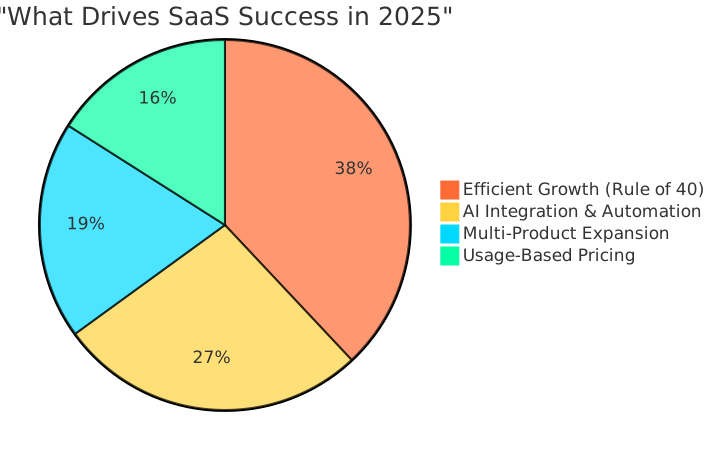
That’s the new reality.
Gone are the days when “growth at all costs” impressed investors.
Revenue & Growth: The New Normal
Growth rates stabilised… but not where you think
Private SaaS companies hit 19-21% median ARR growth in 2024, according to KeyBanc’s survey of 104 companies with median $26M ARR.
Compare that to the top quartile at 27-32%… down from 46% in 2022.
The hypergrowth era is dead.
By company size:
| ARR Range | 2024 Growth | 2023 Growth | Change |
|---|---|---|---|
| <$10M ARR | 19% | 22% | -3% |
| $10-25M | 16% | 18% | -2% |
| $25-50M | 17% | 20% | -3% |
| >$50M | 24% | 28% | -4% |
Here’s the kicker… larger companies are now growing faster than smaller ones.
That flies in the face of conventional wisdom.
But wait till you see what AI-native companies are doing.
AI-native companies are crushing it
High Alpha’s analysis of 800+ companies reveals AI-native startups under $1M ARR hit 100% median growth in 2024.
That’s 2x faster than horizontal SaaS.
Some AI-native companies reached $30M ARR in just 20 months… 5x faster than traditional SaaS which takes 100+ months on average.

Public SaaS? They’re limping along at 17-18% median growth in Q3-Q4 2024.
The gap between winners and losers has never been wider.
Net Revenue Retention: Your growth engine
Here’s a stat that’ll make you rethink everything… companies with NRR ≥100% grow at 48% YoY.
That’s 2x faster than companies below 100%.
ChartMogul’s analysis of 2,500+ businesses shows:
- Private median: 101-102% (holding steady)
- Public median: 108-110%
- Best-in-class: 120%+
But here’s where it gets interesting… NRR varies wildly by ARPA.
By monthly ARPA:
| ARPA Range | % Achieving >100% NRR | Median NRR |
|---|---|---|
| <$25/month | 2% | 94% |
| $500+/month | 47% | 105% |
| $1,000+/month | 47% | 105% |
Only 2% of companies with sub-$25 ARPA achieve negative churn.
Nearly half of those charging $500+ do.
Pricing matters more than you think.
Revenue per employee surged
This one shocked us.
SaaS Capital’s 2025 survey of 1,000+ companies reveals median revenue per employee hit $129,724.
Public SaaS? $283K median, $369K top quartile.
The target for IPO? $300K+.
By company size:

Here’s why this matters… companies under $5M ARR reduced headcount 25-41% whilst maintaining growth.
AI isn’t coming. It’s already here.
And it’s slashing labour costs faster than anyone predicted.
Want to understand the hidden costs of building SaaS products? We’ve analysed the real numbers behind profitable SaaS businesses.
Customer Acquisition: The Brutal Truth
CAC by channel… and the winners are shocking
First Page Sage analysed 120+ B2B companies and found massive variations in customer acquisition costs.
Organic channels (lowest CAC):
| Channel | B2B CAC | ROI |
|---|---|---|
| Email Marketing | $53 | Highest |
| Advanced SEO | $341 | Very High |
| Content Marketing | $533 | High |
Paid channels (highest CAC):
| Channel | B2B CAC | ROI |
|---|---|---|
| Social Ads | $937 | Lowest |
| Display Ads | $841 | Low |
| PPC | $619 | Medium |
Email marketing costs $53 to acquire a customer.
Social ads? $937.
That’s a 17.7x difference.
But here’s what nobody talks about… the New CAC Ratio (how much you spend to generate $1 of new ARR) has gotten worse.
CAC Ratio worsened in 2024
Benchmarkit’s analysis of 936 companies shows:
- Median New CAC Ratio: $2.00 (up 14% from 2023)
- Target: $1.50 or lower
- Blended (new + expansion): $1.59
You’re now spending $2.00 to generate $1 of new ARR.
That’s unsustainable without strong retention.
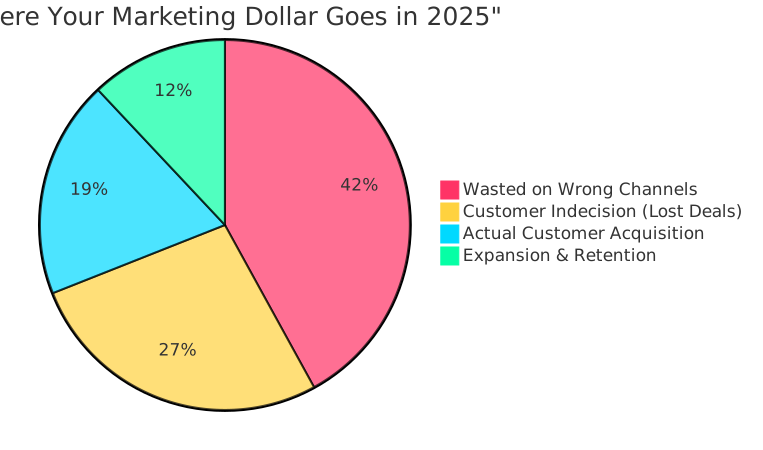
Nearly half your marketing spend is wasted.
But there’s good news… CAC payback improved.
CAC payback by deal size
By ACV (Benchmarkit 2025):
| ACV Range | CAC Payback Period |
|---|---|
| <$5K | 9 months |
| $10-25K | 12 months |
| $25-50K | 14 months |
| >$250K | 24 months |
KeyBanc found median payback hit 20 months in 2024… down from 25 months in 2022.
That’s progress.
But compare it to the historical 12-14 months and you’ll see we’re still in trouble.
The Magic Number is climbing
The Magic Number (how much new ARR you generate per dollar of S&M spend) hit 0.90 median in 2024.
Target? 1.0+.
Top quartile? >2.0.
Only the elite are generating $1+ of ARR for every dollar spent on sales and marketing.
Sales metrics that matter
AE Performance Benchmarks (2024):
| Metric | Median | Top Quartile |
|---|---|---|
| Annual Quota | $750,000 | $1.2M+ |
| Quota Attainment | 70-75% | 85%+ |
| New ARR per AE | $328,000 | $550K+ |
| OTE (Total Comp) | $190,000 | $250K+ |
Bridge Group’s research shows median AE tenure dropped to 2.2-2.5 years.
SDRs? 14 months… and 52% don’t last 12 months.
Win rates and loss reasons
Here’s the stat that’ll change how you think about competition…
61% of lost deals are due to buyer indecision.
Only 14% to competitors.
Gong’s analysis reveals median win rates hit 19% in 2024… down from 23% in 2022.
But with former advocates? 49% win rate.
That’s a 2.6x multiplier.
Your existing network is worth more than any outbound campaign.
Looking to optimise your SaaS development process and reduce acquisition costs? We specialise in rapid prototyping and scalable architecture.
Retention & Churn: The Make-or-Break Metrics
Churn rates by customer segment
ChartMogul’s 2,500+ business analysis shows churn varies wildly by ARPA.
SMB (sub-$25 ARPA):
- Monthly MRR churn: 8.2% gross, 6% net
- Annual churn: 31-58% (you’re replacing half your customers yearly)
Mid-Market ($500+ ARPA):
- Monthly churn: 2.4% gross, 0.4% net
- Annual churn: 11-22%
Enterprise:
- Monthly churn: ~1%
- Annual churn: 6-10%

SMB churn is 8.2x higher than enterprise.
If you’re targeting small businesses, you need expansion revenue to survive.
LTV:CAC ratios reality check
The standard advice? Aim for 3:1 or higher.
Benchmarkit found median LTV:CAC hit 3.6:1 in 2024.
But here’s the breakdown by channel:
LTV:CAC by acquisition channel:
| Channel | LTV:CAC Ratio |
|---|---|
| Organic SEO | 6:1 |
| Content Marketing | 5:1 |
| 4:1 | |
| Paid Search | 2.5:1 |
| Social Ads | 1.8:1 |
Social ads barely break even.
SEO delivers 3.3x better unit economics.
This is why our micro-SaaS revenue analysis emphasises organic growth strategies.
Expansion revenue is the new growth
Companies with $15-30M ARR get 40% of growth from expansion… up from 30% in 2021.
For companies with ARPA >$1,000… 40% of total ARR comes from expansion.
Companies with ≥100% NRR? >50% from expansion.
Negative churn prevalence:
| ARR Range | % Achieving Negative Churn |
|---|---|
| <$300K | 9% |
| $15-30M | 40% |
| ARPA >$1,000 | 47% |
Nearly half of high-ARPA companies achieve negative churn.
That means they grow without acquiring a single new customer.
Profitability: The New Religion
Gross margins holding strong
Subscription gross margins:
- Median: 79%
- Top quartile: 85%+
- Target: 80%+
Total gross margins (including services): 71-72%.
If you’re below 70%, you’ve got a cost structure problem.
Operating margins improving
Blossom Street’s Q1 2025 public SaaS data shows:
- Median operating margin: -9%
- Profitable companies: ~11% median
- Private SaaS 2024E: -6% median (up from -26% in 2022)
We’ve gone from “burn cash to grow” to “show a path to profitability.”
The market won’t fund losses anymore.
Rule of 40: More aspiration than reality
The Rule of 40 (growth rate + profit margin ≥ 40%) is the gold standard.
But only 11-30% of companies achieve it.
Public SaaS (Q4 2024):
- Median score: 15%
- % meeting Rule of 40: ~30%
Private SaaS (KeyBanc 2024):
- Median: 15% (up from -7% in 2022)
- % meeting: 11-13%
- Top quartile: 31%
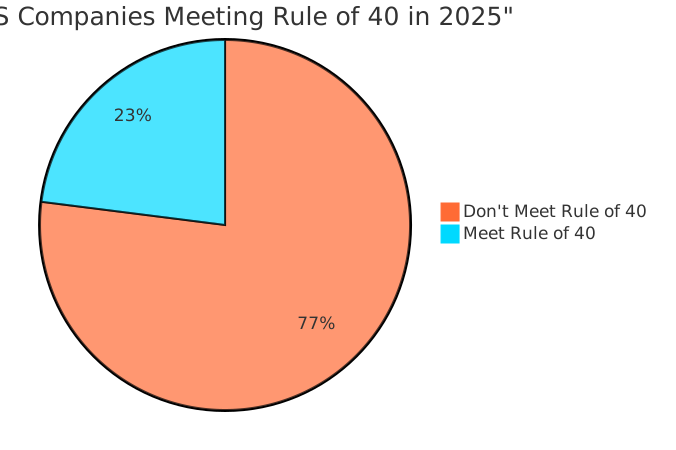
Only 1 in 4 companies meet the standard.
But here’s why it matters… companies with Rule of 40 >40% get valued at 9.4x median revenue.
Companies <20%? 3.5x.
That’s a 121% valuation premium.
Want to see how these metrics affect your SaaS valuation? Use our calculator to model different scenarios.
Cash efficiency worsening
Burn Multiple (how much you spend to generate $1 ARR):
- Best: <1.0x
- Median 2024: 1.8-2.0x
- Concerning: >2.0x
You’re burning nearly $2 to generate $1 of ARR.
Runway by company size (KeyBanc 2024):
| ARR Range | Median Runway |
|---|---|
| <$10M | 18 months |
| $10-25M | 24 months |
| $25-50M | 27 months |
| >$50M | 18 months |
Large companies have concerningly low runway.
The fundraising environment hasn’t recovered.
Pricing & Monetisation: The Revolution
Freemium conversion rates
Lenny Rachitsky’s analysis of 1,000+ products combined with OpenView data shows:
Freemium conversion rates:
| Model | Good | Great | Elite |
|---|---|---|---|
| Self-serve | 3-5% | 6-8% | >10% |
| Sales-assisted | 5-7% | 10-15% | >20% |
Only 15% achieve >20% conversion.
The rest are leaving money on the table.
Free trial conversion
First Page Sage found massive differences by trial type:
Trial structure impact:
| Trial Type | Conversion Rate |
|---|---|
| Opt-in (no credit card) | 18.2% |
| Opt-out (CC required) | 48.8% |
| ≤7 days | 40.4% |
| 61+ days | 30.6% |
Requiring a credit card increases conversion 2.7x.
Shorter trials (≤7 days) outperform long trials.
Urgency matters more than exploration time.
By vertical:
| Industry | Trial-to-Paid Conversion |
|---|---|
| CRM | 29.0% |
| HR | 22.7% |
| Enterprise | 18.6% |
CRM converts 1.6x better than enterprise software.
Pricing structure trends
Average SaaS product has 3.5 tiers… with 3-4 being optimal.
Annual discount sweet spots:
- Most common: 16.7% (“2 months free”)
- Second most common: 8.3% (“1 month free”)
- Median: 15-20%
Price increases accelerating
Paddle’s research shows 42-73% of companies raised or plan to raise prices in 2024.
Median increase? ~20%.
Companies >$1B raised prices 8.4% vs smaller companies at 5.0%.
SaaS inflation is real:
SaaS price inflation hit 8.7-11.4% YoY.
Compare that to G7 market inflation at 2.7%.
SaaS is inflating at 5x the market rate.
ProfitWell found companies updating prices every 6 months gain 2x ARPU vs annual updates.
ARPU by segment
| Segment | Monthly ARPU |
|---|---|
| Enterprise | $1,000-$1,320 |
| Mid-Market | $500-$1,000 |
| SMB | $50-$500 |
KeyBanc found median ACV hit $62,000 in 2024.
Usage-based pricing explosion
This is the biggest pricing shift in SaaS history.
Metronome’s 2025 report reveals 85% adopted or are testing usage-based pricing.
78% adopted within the last 5 years.
50% in just the last 2 years.
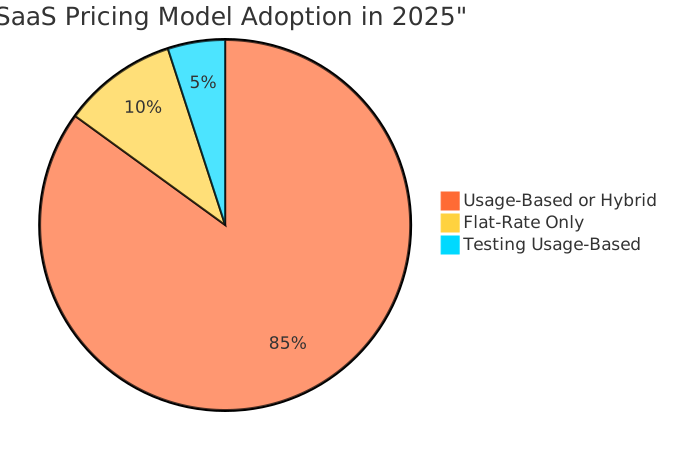
Performance benefits:
| Metric | Improvement vs Flat-Rate |
|---|---|
| NRR | +10% |
| Churn | -22% |
| Growth Rate | 2x faster |
Usage-based pricing delivers 10% higher NRR, 22% lower churn, and 2x faster growth.
API revenue stats:
Postman’s 2024 survey of 5,600+ respondents shows:
- 62% generate revenue from APIs
- 21% derive >75% of revenue from APIs
- 73% increase in AI-driven API traffic
APIs aren’t just plumbing anymore. They’re the product.
Team & Organisational Metrics
Revenue per employee by size
SaaS Capital’s 2025 data shows clear scaling patterns:
| ARR Range | Revenue per Employee |
|---|---|
| $1-3M | $99,858 |
| $10-20M | $159,000 |
| $50M+ | $223,000 |
| Public SaaS | $283,000 |
| IPO Target | $300,000+ |
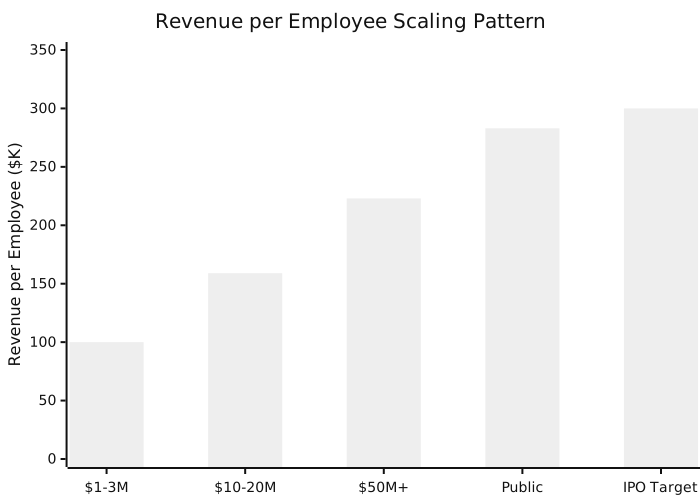
If you’re not hitting $300K+ at scale, you won’t IPO.
Sales productivity benchmarks
AE metrics (2024):
| Metric | Median |
|---|---|
| Annual Quota | $750,000 |
| New ARR Generated | $328,000 |
| Quota Attainment | 70-75% |
| OTE (Total Comp) | $190,000 |
| Tenure | 2.2-2.5 years |
SDR metrics:
| Metric | Median |
|---|---|
| Tenure | 14 months |
| Activities per Day | 70 |
| Don’t Last 12 Months | 52% |
Over half your SDRs won’t make it a year.
CSM ratios
Gainsight’s 2024 research shows:
By touch model:
| Model | Accounts per CSM |
|---|---|
| High-touch | 22 |
| Mid-touch | 49 |
| Low-touch | 144 |
ARR per CSM:
- Target: $1-2M
- Median: $1.4M
- Top quartile: $4.2M
Headcount distribution
Typical allocation:
| Department | % of Headcount |
|---|---|
| Sales & Marketing | 39% |
| Engineering | 30-31% |
| G&A | 25% |
For a $10M ARR company with 100 employees:
- S&M: 40 people
- Product/Eng: 35 people
- G&A: 25 people
Remote work performance
High Alpha’s 2024 data shows:
Work model distribution:
| Model | % of Companies |
|---|---|
| Hybrid | 28-53% |
| Fully in-office | 27% |
| Fully remote | 20-30% |
Performance comparison:
| Model | Median Growth |
|---|---|
| In-office | 50% |
| Remote | 39% |
In-office companies show 28% higher growth.
But Rule of 40 scores are identical… both models can win with right execution.
Span of control
Modern optimal: 5-6 direct reports per manager.
By company size:
| Employee Count | Reports per Manager |
|---|---|
| 50-250 | 4-5 |
| 500-1,000 | 6-7 |
Formula: +1 per 750 employee increase.
Curious about the micro-SaaS market explosion and how team metrics differ at smaller scale? We’ve analysed the complete landscape.
Product Metrics & GTM Strategy
Product-led growth goes mainstream
OpenView’s 2023-2024 research shows 55% identify as product-led… up from 48% in 2020.
61% of Cloud 100 use PLG.
PLG companies grow 2x faster than traditional SaaS.
Conversion funnel:
| Stage | Conversion Rate |
|---|---|
| Website to Signup | 6-9% (freemium), 3-4% (trial) |
| Activation | 20-40% median, 37.5% average |
PQL conversion advantage
Product-Qualified Leads convert 5-6x higher than Marketing-Qualified Leads.
Typical PQL-to-paid: 20-30%.
Traditional MQLs? Only 6% ultimately convert.
Yet only 25% of companies measure PQLs… with 37% on roadmap.
This is a massive missed opportunity costing millions.
Time to value
Userpilot’s analysis of 62 B2B companies shows:
- Average: 1 day, 12 hours, 23 minutes
- Median: 1 day, 1 hour, 54 minutes
Targets by segment:
| Segment | Target TTV |
|---|---|
| SMB | <30 days |
| Mid-Market | 30-90 days |
| Enterprise | 3-6 months |
Feature adoption rates
Core feature adoption (Userpilot 2024, 181 companies):
- Average: 24.5%
- Median: 16.5%
By industry:
| Industry | Feature Adoption |
|---|---|
| HR | 31% |
| Marketing | 24% |
| FinTech | 22.6% |
Only 1 in 4 users adopt your core features.
The rest never see your value.
Multi-product strategy
Performance data:
- Freshworks: 21% use 2+ products (35% for $5K+ customers)
- JFrog: 95% use multiple products
- Economics: 30-70% of revenue from expansions
- 50% less expensive than new customer acquisition
Multi-product is the new growth engine.
Fundraising & Valuation: The New Reality
Public SaaS multiples stabilised
Current valuations (2024-2025):
| Index | Revenue Multiple |
|---|---|
| BVP Nasdaq Emerging Cloud | 8.4x |
| SaaS Capital Index | 7.0x |
| Median NTM Revenue | 5.5-7.0x |
| Top Quartile | 10.7-12.4x |
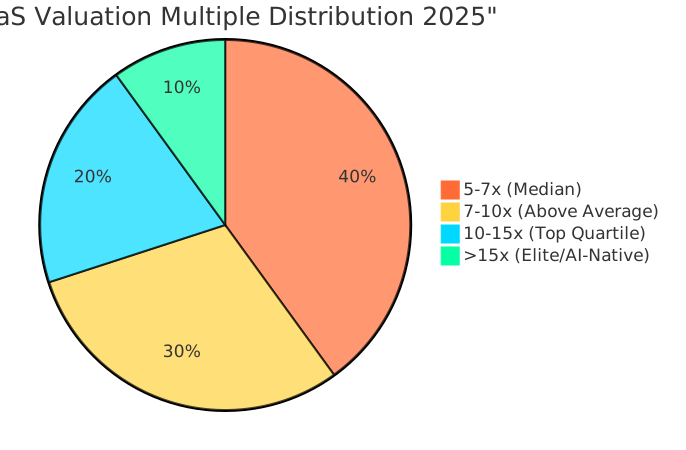
We’re down 65-70% from the 2021 peak of 20-21x.
But at least we’ve stabilised.
Private valuations by stage
Carta’s Q1 2025 data shows:
Pre-money valuations:
| Stage | Valuation | YoY Change |
|---|---|---|
| Seed | $14.8-16M | +8% |
| Series A | $45-48M | +6% |
| Series B | $100-117M | +17% |
| Series C | $195.7M | +48% |
Overall private median: 4.1x ARR (Q4 2024).
Bootstrapped companies command 4.8x predicted.
Equity-backed: 5.3x predicted.
Growth-adjusted multiples
By growth rate:
| Growth Rate | Valuation Multiple |
|---|---|
| 50%+ | 8-12x |
| 30-50% | 6-10x |
| 20-30% | 4-8x |
| <20% | 3-5x |
Rule of 40 impact:
| Rule of 40 Score | Median Multiple |
|---|---|
| >40% | 12.4x |
| <40% | 5.6x |
Companies meeting Rule of 40 get a 121% valuation premium.
That’s $124M vs $56M on $10M ARR.
Time between rounds lengthening
Carta’s 2024 analysis shows:
Months between rounds:
| Round Progression | 2022 | 2024 | Change |
|---|---|---|---|
| Seed to A | 20 | 23.7 | +18% |
| A to B | 22 | 28.4 | +29% |
| B to C | 17 | 27.4 | +61% |
You’re waiting 30-40% longer between rounds.
Plan accordingly.
Dilution rates declining
Good news for founders:
| Stage | 2019 Dilution | 2024 Dilution | Improvement |
|---|---|---|---|
| Seed | 21.5% | 20.0-20.5% | -1.5% |
| Series A | 24.1% | 17.9-20.1% | -4.0% |
| Series B | 20.8% | 14.0-16.7% | -4.1% |
| Series C | 17.5% | 13-15% | -2.5% |
Founders retain 7.6 percentage points MORE equity through Series D in 2024 vs 2019.
Despite market correction, founder-friendly terms improved.
IPO requirements doubled
The bar for IPO has skyrocketed.
2024-2025 requirements:
- Realistic minimum: $250M ARR with 25%+ growth
- Recent IPOs: $400-800M ARR
- Growth: 25%+ YoY minimum, ideally 40%+
- Rule of 40: Must meet or exceed
- Market cap target: $5B+ ($10B+ preferred)
Recent examples:
- ServiceTitan: ~$800M ARR (Dec 2024, opened +42%)
- Rubrik: ~$500M ARR at $5.6B valuation (11.2x)
Down rounds normalised
Prevalence (2024-2025):
| Period | % Down Rounds |
|---|---|
| 2019-2021 | <5% |
| Q1 2024 | 23% (peak) |
| Q2-Q4 2024 | 19-21% |
| 2025 | 19-23% (new normal) |
Nearly 1 in 4 rounds are flat or down.
For Series B+ Enterprise… 41% flat or down in Q2 2024.
Down rounds are the new normal.
Valuation compression from peak
From 2021 peak to 2025:
| Segment | 2021 Peak | 2025 Current | Decline |
|---|---|---|---|
| Public Median | 20-21x | 5.5-7x | 65-70% |
| Private Median | 6.4x | 4.1x | 35% |
| BVP Cloud Index | $3T | $2.1T | ~50% |
Exception: AI-native companies command 20-40% premiums.
Some trade at 100-300x ARR.
The AI hype is real… and potentially dangerous.
Understanding the 18-month rule for micro-SaaS survival can help you avoid becoming a down-round statistic.
Geographic & Vertical Variations
Geographic valuation differences
2024 median multiples:
| Region | Revenue Multiple | Discount vs US |
|---|---|---|
| North America | 6.86x | Baseline |
| Europe | 6.7x | -2% |
| CEE | 3.28x | -52% |
Central and Eastern Europe trades at half the US valuation.
Geographic arbitrage opportunities exist.
European profitability surge
Europe EBITDA-positive companies:
- 2023: 33%
- 2024: 44%
European companies embraced profitability faster than Americans.
Pricing sensitivity by region
PricingSaaS research shows:
- Europeans: 20-25% more price-sensitive than North Americans
- UK/Northern Europe: 20-30% higher WTP for dev tools
- Southeast Asia: 60-70% lower WTP
Conversion rates by region (TestDome):
| Region | Customers per 1,000 Visitors |
|---|---|
| Top tier (US, UK, Nordics) | 9.14 |
| Mid-tier (Western Europe) | 4-5 |
| Lower tier (Southeast Asia) | 0.19 |
That’s a 48x difference between best and worst.
Geography matters more than you think.
Vertical SaaS outperforming
OpenView found vertical SaaS companies are 1.5-3.3x more likely to be outliers.
Market size:
- Current: $157.4B by 2025 (23.9% CAGR)
- Bessemer prediction: Vertical AI will 10x legacy vertical SaaS by 2030
Fintech SaaS stats (Tidemark 2024, 249 companies):
- 39% of vertical SaaS offer fintech products
- Payments most common: 30%
- Take rates: 2.8-3.2% median, 3.5-4.0% top quartile
- Mandatory payments increase attach by 40-60%
M&A dominance:
- 54% of Q3 2025 SaaS M&A was vertical (up from 43% YoY)
- Healthcare: 18% of deals
- Financial Services: 14%
B2B vs B2C economics
Growth rates (2024):
- B2B: 11% CAGR
- B2C: 8% CAGR
Unit economics comparison:
| Metric | B2B | B2C |
|---|---|---|
| ARPU | $100-$1,000+/month | $5-$10/month |
| Monthly Churn | 1-5% | 5-10%+ |
| LTV:CAC | 3-5x | 1-3x |
Example CAC budget:
- B2B ($70/month, 3% churn): Can spend $280 per acquisition
- B2C ($7/month, 10% churn): Can only spend $2.80 per acquisition
That’s a 100x difference in acquisition budget.
SaaSyTrends analysed 30,000 companies and found:
- B2B success rate: 61.1%
- B2C success rate: 64.2%
Interestingly, B2C has slightly higher success rates… but lower revenue potential.
Forward-Looking Trends: What’s Next
AI impact accelerating
Current adoption:
- 60%+ of enterprise SaaS have embedded AI
- 95% expected to adopt by 2025
- AI-native reaching $30M ARR in 20 months… 5x faster than traditional
Growth advantage:
- AI-native: 22% higher growth than horizontal SaaS
- 3.3x more likely to be outliers
- Nearly 70% monetising or testing monetisation
Market projections:
- $770.32B by 2031 (40.2% CAGR)
- $59B in GenAI funding in 2024 (+119% YoY)

Efficiency gains:
Companies <$5M ARR show 25-41% headcount reduction whilst maintaining growth.
Employees saving 12 hours/week on average.
AI isn’t a feature. It’s a fundamental restructuring of how software works.
Consumption pricing goes mainstream
Adoption trajectory:
- 2023: 28%
- 2024: 85% adopted or testing
- 2025: 59% expect growth as % of revenue
50% adoption happened in just 2 years.
Performance benefits:
| Metric | Improvement |
|---|---|
| NRR | +10% |
| Churn | -22% |
| Growth Rate | 2x |
Usage-based pricing isn’t optional anymore.
Product-led sales emergence
Adoption:
- 2021: 35% identify as product-led
- 2024: 60%
- 90%+ investing in PLS approach
- 97% investing in product-focused experience
Performance:
- 2x median enterprise value of non-PLG
- PLG grows 50% YoY vs 21% traditional
- All top 2019 IPOs were PLG businesses
The consumerisation of B2B is complete.
Vertical SaaS & multi-product domination
M&A activity:
- 54% of Q3 2025 M&A was vertical SaaS
- 2,107 transactions in 2024 (2nd highest on record)
Vertical AI predictions:
- Market cap 10x legacy vertical SaaS (Bessemer)
- 400% growth rates with ACVs ~80% of traditional
- First Vertical AI IPO within next 3 years
The horizontal SaaS era is ending.
Vertical-first wins.
Embedded finance explosion
Market size:
- 2024: $104.8-146.2B
- 2030-2034: $690B-$1.43 trillion (23-36% CAGR)
- 56% of businesses offer at least one embedded finance form
SaaS adoption:
- 50%+ of relevant ISVs offering embedded payments (2025)
- Expected to reach 45% of SME acquiring revenues by 2028
Payments as a feature becomes table stakes.
IPO market outlook
2025 predictions:
- At least 10 enterprise software IPOs (Sapphire)
- 52 new U.S. IPOs priced (up 62.5% vs 2024)
- Q1 2025: 59 IPOs raised $8.9B (55% increase)
Performance requirements:
- ~63% growth rate in year before IPO
- 59% of Q1 2025 IPOs were profitable (vs 29% in Q1 2024)
- Valuation: AI-native 15-20x ARR, traditional 6-8x
Pipeline:
Figma, Genesys, Databricks, Stripe, Klarna all filed or IPO-ready.
The IPO window is cracking open.
VC funding trajectory
2025 predictions:
- Global VC funding to exceed $400B (double-digit growth)
- Enterprise software: 42% of all VC (all-time high)
- $155B deployed in enterprise software (up 27% YoY)
GenAI funding:
- 2024: $59B (+119% YoY)
- 2025: Growth expected <100% (law of large numbers)
- Application layer sees greatest expansion
The venture market recovered faster than expected.
Surprising & Contrarian Insights
1. The Founder-Friendly Dilution Paradox
Despite market correction, founders retain 7.6% MORE equity through Series D in 2024 vs 2019.
Dilution declined even as valuations compressed.
Counter-intuitive but true.
2. The $200M Valuation Wall
Very few “traditional” (non-AI) SaaS can raise above $200M post-money in 2024.
Mathematical impossibility for VCs to achieve returns with 5-7x exit multiples.
You either go AI-native or bootstrap to profitability.
3. AI Valuation Premium Exceeds 2021
Private AI startups MORE overvalued vs publics than in 2021… 3.2x premium vs 1.8x in 2021.
Battery Ventures data shows we’re in bubble territory.
Again.
4. Expansion CAC Tripled
2010: $0.28 expansion CAC.
2024: $1.00 (3.6x increase).
Rising expansion CAC particularly concerning as 35% of revenue now comes from expansion.
Your most valuable customers cost more to upsell than ever.
5. The ACV Efficiency Paradox
$25K-$50K ACV range MORE efficient to acquire than $50K-$100K.
Contradicts conventional wisdom that bigger deals = better economics.
Benchmarkit 2024 proves it.
6. Indecision Beats Competition
61% of lost deals due to buyer indecision.
Only 14% to competitors.
Top reps are 364% less likely to lose to indecision.
You’re not competing against other vendors. You’re competing against status quo.
7. PQL Tracking Gap
Only 25% measure PQLs despite 5-6x higher conversion than MQLs.
Massive missed opportunity costing companies millions annually.
Why isn’t everyone tracking this?
8. Rule of 40 More Aspiration Than Reality
Only 11-30% of companies achieve it.
Yet it drives 121% valuation premium.
Companies >40 valued at 9.4x vs 3.5x for <20.
The bar is high. Very few clear it.
9. Remote Growth Gap
In-office companies show 50% median growth vs remote 39%.
But Rule of 40 identical for both.
Both models can succeed with right execution.
Location matters less than leadership.
10. SaaS Inflation 5x Market Rate
SaaS price inflation 8.7-11.4% YoY vs G7 market inflation 2.7%.
Salesforce price increases equal 72% of go-forward growth.
Price increases are the new growth lever.
11. API Revenue Concentration
21% of companies derive >75% of revenue from APIs.
APIs aren’t just plumbing. They’re the product.
Postman’s 2024 data shows the API economy is real.
12. The Seven-Day Window
40.4% conversion for ≤7 day trials vs 30.6% for 61+ days.
Urgency matters more than exploration time.
Shorter trials convert better.
The Bottom Line
The SaaS industry transformed fundamentally in 2024-2025.
The winners’ formula:
- AI-native or AI-enabled products (2x growth advantage)
- Vertical specialisation with multi-product strategy (3.3x outlier likelihood)
- Usage-based or hybrid pricing (10% higher NRR, 22% lower churn)
- Product-led growth + sales hybrid model (2x enterprise value)
- Rule of 40 achievement (121% valuation premium)
- ARR per employee >$300K at scale (IPO readiness)
The market reality:
- Growth stabilised at 19-21% median (down from 40%+ in 2021)
- Profitability now matters: 44% already EBITDA positive
- Only 11-30% achieve Rule of 40
- Down rounds normalised at 19-23%
- IPO bar doubled to $400-800M ARR minimum
The AI inflection:
This isn’t “SaaS + AI features.”
It’s “AIaaS”… a fundamental reimagining where software completes tasks autonomously.
Companies <$5M ARR already show 25-41% headcount reduction whilst maintaining growth.
By 2030, most developers may become “code reviewers” rather than writers.
The urgency:
The window for transformation closes in 2025-2026.
Companies making moves now will be the survivors.
After that, it’s game over for late adopters.
Your Next Steps
Ready to build a SaaS product positioned for 2025’s market realities?
Book a no-obligation consultation with Vikas, who specialises in rapid prototyping and delivering robust web solutions.
Or explore our full range of services including SaaS development, API architecture, and product strategy.
Want to model your metrics? Try our SaaS Valuation Calculator to see how growth, profitability, and Rule of 40 affect your company’s worth.
Sources and References
This report synthesises data from 2,000+ companies across multiple authoritative sources:
KeyBanc Capital Markets & Sapphire Ventures - 2024 Private SaaS Survey (15th Annual), n=104 companies, median $26M ARR
High Alpha/OpenView - 2024 SaaS Benchmarks Report, n=800+ companies
Battery Ventures - State of the OpenCloud 2024, 43 pages
Bessemer Venture Partners - State of the Cloud 2024, Cloud 100 analysis
ChartMogul - SaaS Retention Report 2024, n=2,500+ businesses
SaaS Capital - 14th Annual Survey 2025, n=1,000+ companies
Benchmarkit - 2024 SaaS Performance Metrics, n=936 companies
Software Equity Group - 2025 SaaS Report, M&A transaction data
Metronome & Greyhound Capital - 2025 State of Usage-Based Pricing, n=100
Postman - 2024 State of the API Report, n=5,600+ respondents
Userpilot - 2024 Product Metrics Benchmark, n=547 companies
Bridge Group - 2024 SaaS AE Metrics & Compensation Report
Gainsight - CSM Ratio Benchmarks (Horizon AI Labs)
Carta - Quarterly State of Private Markets (Q1-Q4 2024, Q1 2025)
First Page Sage - 2025 Reports, n=86-120 SaaS companies
GP Bullhound - European SaaS Report 2024
Tidemark Capital - 2024 Vertical & SMB SaaS Benchmark, n=249
Paddle - SaaS Market Reports (Monthly 2024-2025)
Blossom Street Ventures - Public SaaS Data (Q1-Q4 2024), n=58-60
ProfitWell/Paddle - Research from 30,000+ subscription companies
Additional sources include Meritech Capital, Jamin Ball/Clouded Judgement, PitchBook, McKinsey, Gartner, Recurly, Stripe, Tomasz Tunguz, SaaStr, PricingSaaS, Revenera, and 15+ additional industry sources.
Note: All pricing and metrics data was last verified in November 2024 through January 2025 and represents average ranges across multiple authoritative sources. Actual results may vary based on specific market conditions, company stage, vertical, and execution quality.
Vikas Thakur
Founder of RockingWeb and experienced SaaS entrepreneur with two decades of expertise in web development, conversion optimisation, and digital marketing. Passionate about helping businesses maximise their online potential through data-driven strategies and cutting-edge technology solutions.
Learn more about Vikas![92% of Micro SaaS Fail Within 18 Months [2025 Survival Data]](/assets/18-month-rule-micro-saas-CBuP5ufy.png)
![Micro SaaS Costs $47,000 Not $5,000: Real Budget Breakdown [2025]](/assets/micro-saas-costs-BZycNqTa.png)
![1,000 Micro SaaS Analysed: Real Revenue Data [2025 Study]](/assets/micro-saas-Cib6WkG5.png)
![Facebook Ads Benchmarks 2025: Shopping CTR Surged 146% [Industry Data]](/assets/facebook-ads-benchmarks-2025-DWNLfm9o.png)