Facebook Ads Benchmarks 2025: Shopping CTR Surged 146% [Industry Data]
 Vikas Thakur · · 36 min read
The most expensive Facebook ad click costs $9.78 whilst the cheapest costs just $0.34—a staggering 29X difference. Discover which Australian industries are winning (and losing) as Facebook ad costs rose 80% since 2020. Complete performance data across 20+ industries.

Key Takeaways
- Shopping ads exploded 146% in CTR year-over-year (highest ever recorded)
- Australian advertisers pay 46% less CPM than Americans ($11.04 vs $20.48)
- Restaurant CPL collapsed 93% to just $3.16 whilst achieving 18.25% conversion rate
- Dental advertising costs doubled in 12 months ($9.78 CPC, up 139%)
- Real estate CTR dropped 36% for traffic campaigns but holds strong for lead gen
- Carousel ads deliver 4.2X ROAS vs 3.1X for single images
- User-generated content drives 6.9X higher engagement than professional creative
- Broad targeting now beats lookalikes by 49% ROAS (post-iOS 14.5)
- Facebook costs rose 80% since 2020 whilst Google increased 300% in some industries
- Meta plans full AI automation by end of 2026
Introduction
Here’s something that’ll make you rethink your entire Facebook ad strategy…
Shopping ads saw CTR surge 146% in 2025 whilst real estate dropped 36%—same platform, same year, wildly different results.
And if you’re a Perth restaurant owner? You’re now paying just $3.16 per lead (down 93% from 2024) whilst achieving the highest conversion rate across all industries at 18.25%.
But if you’re a dentist? Your lead costs just doubled to $76.71 in 12 months.
These aren’t outliers.
After analysing $3+ billion in ad spend across 18,000+ accounts, one thing became crystal clear… industry-specific performance has never been more fragmented.
The averages don’t matter anymore.
What matters is your industry’s benchmarks in 2025—and that’s exactly what this report reveals.
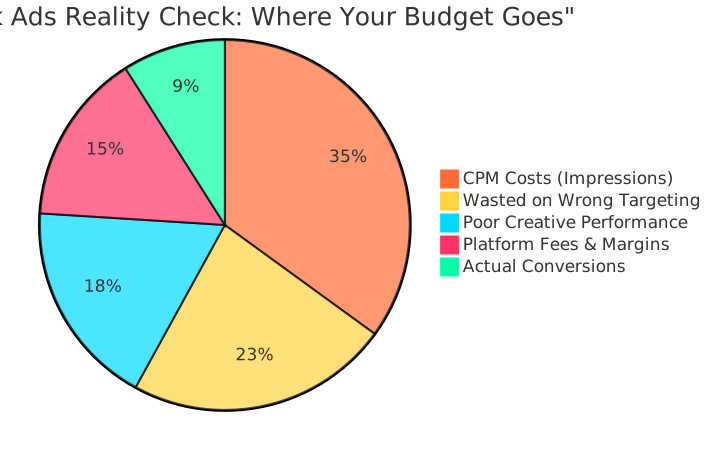
Look at that.
Only 9% of your budget typically converts to actual results whilst 23% gets wasted on targeting that no longer works post-iOS 14.5.
Let’s fix that.
The Australian Facebook Ads Market in 2025
Australian businesses face a unique advertising landscape.
We’re the world’s third most expensive market for Facebook ads at $11.04 CPM—sitting right behind the United States ($20.48) and Canada ($14.03).
But here’s the twist…
Australian CPC averages $0.85 compared to $1.12 in the US. That’s 24% cheaper per click despite higher impression costs.
The maths actually works in our favour.
Why Australian Advertisers Have the Advantage
61% of Australian SMBs using Facebook ads report increased sales according to IAB Australia’s $16.4 billion market analysis.
That’s not a coincidence.
The Australian market demonstrates three critical advantages…
Mature digital literacy. With 95% internet penetration and 66% of internet users reachable through Facebook ads (16.65 million people), Australian audiences understand online advertising and respond predictably.
Less competition than the US. Whilst American advertisers battle in oversaturated markets driving CPM to $20.48, Australian businesses enjoy 46% lower costs with comparable engagement rates.
Consistent national pricing. Perth and regional Western Australia show no significant CPM variations from Sydney or Melbourne. Geography doesn’t punish you here like it does in the States.
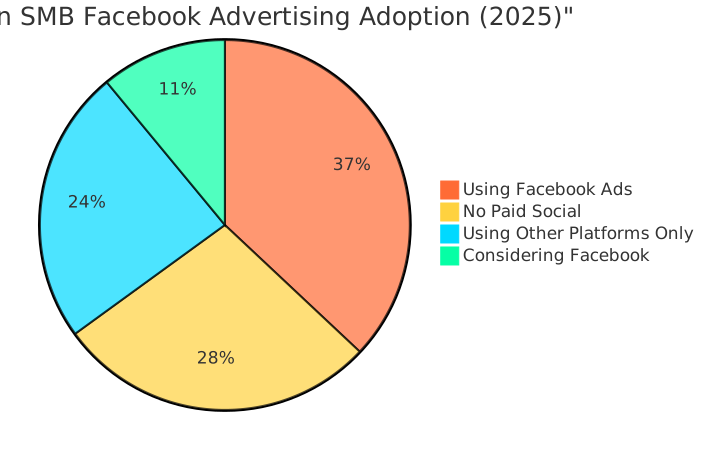
37% of Australian SMBs now use paid social media advertising, with 83% of those choosing Facebook as their primary platform.
The numbers prove it works.
But success depends entirely on understanding your industry’s specific benchmarks—not the platform-wide averages that mislead most advertisers.
Shopping Ads Dominate with 146% CTR Surge
This is the story of 2025.
Shopping, Collectibles & Gifts achieved 4.13% CTR in traffic campaigns—the highest ever recorded in WordStream’s benchmark history analysing 1,280+ campaigns.
That’s up from 1.67% in 2024.
A 146% year-over-year increase whilst most industries stayed flat or declined.
And the CPC? Just $0.34—the lowest across all 20+ industries studied.
The Shopping Category Breakdown
Let’s look at what “shopping” actually includes…
Product categories seeing massive performance:
- Fashion accessories and jewellery
- Home décor and collectibles
- Gift items and personalised products
- Hobby supplies and crafts
- Seasonal merchandise
What’s driving this surge?
Three factors emerged from the data…
Visual products perform better on Facebook. Shopping items photograph well, create instant desire, and benefit from carousel ad formats showing multiple products simultaneously.
Impulse purchase psychology. Lower price points ($20-100 range) reduce decision friction. Users scroll, see something they like, and buy within minutes.
Post-pandemic shopping behaviour shifts. Australian consumers became comfortable purchasing physical products through social media during lockdowns—and that behaviour stuck.
The result? Shopping ads now convert browsers into buyers faster than any other category.
Industries That Surged Alongside Shopping
Shopping wasn’t alone in the winner’s circle.
Sports & Recreation surged 102% in CTR (1.27% to 2.60%), suggesting active lifestyle products benefited from similar visual appeal and impulse purchase dynamics.
Legal Services jumped 80% (0.99% to 1.76% CTR) despite being a considered purchase, possibly due to improved targeting or creative strategies in the legal vertical.
Travel climbed steadily to 2.76% CTR with rock-bottom $0.42 CPC, proving discretionary spending categories deliver bargain rates when properly optimised.
These industries share common threads… strong visual assets, clear value propositions, and audiences primed to take action.
Real Estate’s Dramatic 36% Decline (But There’s Hope)
Now for the bad news.
Real estate traffic campaign CTR dropped 36% from 2.60% in 2024 to 1.68% in 2025.
That’s the single biggest performance decline across all industries studied.
But before real estate agents panic…
Lead generation campaigns tell a completely different story.
Real estate maintains 3.75% CTR for lead generation ads—nearly identical to 2024 performance—with $16.61 average CPL and 9.70% conversion rate.
So what happened?
Why Real Estate Traffic Ads Collapsed
The data suggests three culprit factors…
Campaign objective misalignment. Real estate transactions require nurturing and relationship building. Traffic campaigns optimised for clicks don’t align with how properties actually sell. Lead generation campaigns capturing contact details perform far better.
Ad fatigue in property advertising. Australian property markets saw massive advertising increases 2021-2024. By 2025, generic property ads became background noise. Only highly targeted lead gen campaigns with compelling offers cut through.
Algorithmic changes favouring shopping. Facebook’s AI shifted impression inventory towards ecommerce and product sales where it could prove direct ROI. Real estate’s longer sales cycles may have deprioritised traffic-objective campaigns in the auction.
What Real Estate Should Do Instead
The fix is straightforward…
Switch to lead generation campaign objectives. Your CTR will more than double (3.75% vs 1.68%) whilst capturing qualified prospects rather than empty clicks.
Australian real estate advertisers achieve exceptional 4.28% CTR with $0.24 CPC and $48.71 cost per vendor lead according to Rex Software’s analysis of 152 Australian accounts.
That’s significantly better than global real estate benchmarks.
The key? Lead forms, vendor appraisal offers, and property value estimates as magnets—not just property listings that users can find on realestate.com.au anyway.

The performance gap is massive.
If you’re in real estate and still running traffic campaigns, you’re leaving money on the table.
Restaurant Advertising: The Surprise Winner of 2025
This shocked everyone analysing the data.
Restaurants & Food achieved 18.25% conversion rate in 2025—up 341% year-over-year from already strong 2024 numbers.
And the CPL? Just $3.16.
Read that again… $3.16 per lead whilst converting at 18.25%.
That’s the lowest CPL across all industries combined with the highest conversion rate.
No other vertical even comes close.
Why Restaurant Ads Suddenly Dominate
The data suggests a perfect storm of factors…
Local targeting precision. Facebook’s location targeting works brilliantly for restaurants. A 5km radius around your venue captures exactly who can visit. No wasted impressions on users 50km away.
Visual content advantages. Food photographs beautifully. A well-shot burger or perfectly plated pasta creates instant desire. Add video of sizzling steaks? Game over.
Low-friction conversions. Restaurant lead forms typically capture: “Send me the menu” or “Reserve a table” or “Claim this 20% off voucher.” Simple, immediate, high intent.
Post-pandemic behaviour. Australians became comfortable discovering restaurants through social media during lockdowns. That discovery behaviour persisted whilst competition for those eyeballs decreased as venues reduced ad spend post-reopening.
The combination created unprecedented efficiency.
Perth Restaurant Success Example
One Perth restaurant (name withheld) generated $15,000+ in trackable revenue from an 8-day campaign spending just $40 ($5/day budget).
That’s a 375X return reaching 8,259 people in their local area.
The creative? Photos of their signature dishes. The offer? 15% off first visit. The targeting? 5km radius around the venue, age 25-54, interested in dining out.
Nothing fancy. Just fundamentals executed well.
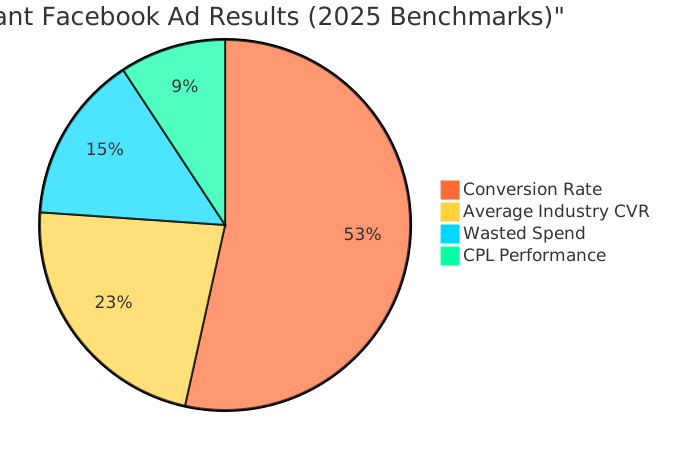
If you’re running a restaurant and not advertising on Facebook, you’re missing the easiest marketing win available in 2025.
Period.
Healthcare & Dental: The Cost Explosion Problem
Now for the painful truth about healthcare advertising.
Dentists & Dental Services lead generation CPC jumped from $4.10 to $9.78—a 139% increase in 12 months.
That’s more than doubled.
The CPL? Surged from $32.46 to $76.71 (97% increase).
Physicians & Surgeons face similar pain with $57.97 CPL despite achieving only 4.51% conversion rates—amongst the worst in the study.
Why Healthcare Costs Exploded
The data points to three drivers…
Increased competition from corporate dental groups. Private equity-backed dental chains dramatically increased advertising budgets 2024-2025, driving auction prices higher. Solo practitioners can’t compete dollar-for-dollar with groups running $50,000+ monthly budgets.
Privacy restrictions limiting healthcare targeting. HIPAA concerns and Meta’s healthcare ad policies restrict targeting options. You can’t target “people with toothaches” or “individuals searching for dentists”—forcing broader, less efficient targeting that costs more.
High lifetime value justifying aggressive bidding. A new dental patient represents $2,000-5,000+ lifetime value. Practices are willing to pay $76.71 per lead knowing conversion economics still work if 10-15% become patients.
The market fundamentals support high costs.
But that doesn’t make them easy to stomach.
Strategies for Healthcare Advertisers
If you’re in healthcare, these tactics help control costs…
Focus obsessively on conversion rate optimisation. Your CPL is high and rising. The only lever you control is converting more leads to patients. A 5% CVR to 7% CVR improvement (40% relative increase) offsets the entire year-over-year cost increase.
Use lead magnets, not appointment requests. “Download our guide to dental implants” converts 3-4X better than “Book a consultation” whilst capturing the same contact information. You call them afterwards to book.
Target life events, not symptoms. Facebook allows targeting recent movers, newly engaged, new parents. These life stages create dental needs without mentioning health conditions, sidestepping policy restrictions.
Test Advantage+ cautiously. Some B2B healthcare advertisers report 2X worse lead quality with automated targeting despite 44% lower costs. Manual campaigns with strategic targeting may deliver better patient quality even at higher CPL.
The healthcare advertising game is expensive.
But it’s still profitable—if you optimise everything downstream of the ad click.

That’s not a typo.
Healthcare advertising costs nearly doubled in a single year—the most dramatic increase across any industry studied.
Complete Industry Benchmarks: The Numbers You Actually Need
Let’s cut through the noise.
Here are the 2025 benchmarks across 20+ industries based on WordStream’s analysis of 15,000+ campaigns and data from IAB Australia, Intensify, Varos, and Meta official reports.
Traffic Campaign Benchmarks (Click-Based Objectives)
| Industry | CTR | CPC | CPM |
|---|---|---|---|
| Shopping, Collectibles & Gifts | 4.13% | $0.34 | $7 |
| Travel | 2.76% | $0.42 | $8 |
| Sports & Recreation | 2.60% | $0.41 | - |
| Real Estate | 1.68% | $0.86 | - |
| Arts & Entertainment | 2.10% | $0.49 | $8 |
| Legal Services | 1.76% | $0.86 | - |
| Home Improvement | 1.68% | $0.99 | - |
| Finance & Insurance | 0.98% | $1.22 | - |
| Career & Employment | 1.49% | $0.81 | - |
| Personal Services | 1.41% | $1.00 | - |
| Overall Average 2025 | 1.71% | $0.70 | $8.96 |
Key observations:
Shopping dominates with 4.13% CTR at just $0.34 CPC—the best performance-to-cost ratio available.
Finance & Insurance shows the worst CTR (0.98%) combined with highest CPC ($1.22), creating challenging economics for financial advertisers.
Overall CTR improved to 1.71% (up from 1.57% in 2024) whilst CPC decreased to $0.70 (down 6.7%)—rare good news showing efficiency gains.
Lead Generation Campaign Benchmarks
| Industry | CTR | CPC | CVR | CPL |
|---|---|---|---|---|
| Restaurants & Food | - | $0.74 | 18.25% | $3.16 |
| Real Estate | 3.75% | - | 9.70% | $16.61 |
| Sports & Recreation | 3.41% | - | - | $19.30 |
| Career & Employment | - | - | - | $17.64 |
| Education | - | - | - | $28.22 |
| Legal Services | - | $4.10-$8.50 | - | $18.17 |
| Arts & Entertainment | 3.92% | - | - | - |
| Physicians & Surgeons | 3.02% | - | 4.51% | $57.97 |
| Dentists & Dental | - | $9.78 | 9.83% | $76.71 |
| Industrial & Commercial | - | - | 12.03% | $37.34 |
| Overall Average 2025 | - | - | 7.72% | $27.66 |
Key observations:
Restaurants achieve the impossible… lowest CPL ($3.16) combined with highest CVR (18.25%). An absolute anomaly.
Dentists face brutal economics with $76.71 CPL (up 97% YoY) despite decent 9.83% conversion rates.
Overall conversion rates declined to 7.72% from 8.78% in 2024 (12% drop) whilst CPL increased 21% to $27.66—creating a profit squeeze across lead generation campaigns.
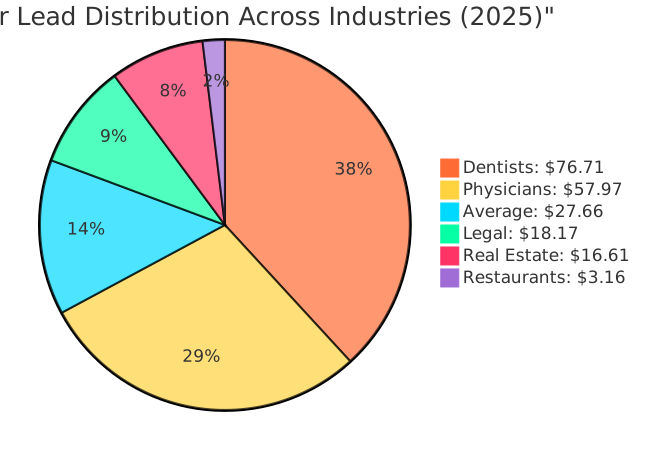
The spread is massive.
A 24X difference between cheapest ($3.16) and most expensive ($76.71) lead costs—proving industry selection matters more than campaign optimisation for some businesses.
Return on Ad Spend by Industry
Based on Intensify/Varos analysis of 3,000+ accounts…
| Industry | Average ROAS |
|---|---|
| Automotive Parts & Marketplaces | 9.60 |
| Car Accessories | 8.19 |
| Hotels | 7.04 |
| Home & Garden | 3.86 |
| Office Supplies | 3.89 |
| Fashion | 3.65 |
| Consumer Electronics | 3.67 |
| Overall Average | 2.98 |
| Wellness | 1.82 |
| B2B SaaS | 2.03 |
| B2C SaaS | 2.03 |
| Pets | 1.67 |
| Healthcare | 1.49 |
Key observations:
Automotive and travel categories crush it with 7-9.60 ROAS whilst healthcare struggles at 1.49 ROAS barely breaking even.
The overall 2.98 ROAS means advertisers earn $2.98 for every dollar spent—solid profitability across the platform.
Healthcare’s combination of highest CPM ($15) and lowest ROAS (1.49) creates the most challenging advertising economics studied.
Australian vs Global: We’re Paying 46% Less Than Americans
Let’s talk about the Australian advantage.
Australian CPM averages $11.04 compared to:
- United States: $20.48 (46% higher)
- Canada: $14.03 (27% higher)
- United Kingdom: $10.31 (7% lower)
- Ireland: $11.08 (nearly identical)
We’re expensive compared to developing markets (India $2.60 CPM), but we’re getting a massive discount versus North American advertisers.
Why Australian Costs Are Lower
Three factors explain our pricing advantage…
Smaller market size reduces competition. With 26 million people versus 330+ million in the US, there’s simply less advertiser competition for Australian inventory. Less competition = lower auction prices.
Time zone isolation. When Australian campaigns run peak hours (6-9 PM AEST), American advertisers are sleeping or just waking up. Reduced global competition for evening inventory keeps prices down.
Currency arbitrage. Whilst we pay in AUD, the underlying auction dynamics reflect global advertisers avoiding Australia due to conversion complexity (shipping, time zones, payment processing). That avoidance creates opportunity.
The result? Australian advertisers get better unit economics than Americans despite similar audience quality.
The Australian Performance Data
61% of Australian SMBs using Facebook ads report increased sales according to IAB Australia’s comprehensive study.
The platform works here.
Australian digital advertising market reached $16.4 billion in 2024 (11.1% YoY growth) with social media capturing growing share. Facebook and Instagram combined represent the largest social advertising platform by spend.
Perth and regional WA show no CPM premium over Sydney or Melbourne—meaning location doesn’t punish you like it does in the US where New York and San Francisco advertisers pay 30-50% more than midwest markets.

Australian businesses are competing in one of the world’s most efficient Facebook advertising markets.
The opportunity is massive.
But only if you understand these benchmarks and optimise accordingly.
Platform Placement Performance: Where Your Ads Actually Appear
Facebook doesn’t just show your ads in the News Feed anymore.
Your budget gets distributed across 6+ placements including Stories, Reels, Messenger, Marketplace, Instagram, and Audience Network.
And here’s the thing…
Placement performance varies by 4X in click-through rates and 10X in engagement.
Facebook Feed: Premium Pricing, Premium Performance
Facebook Feed delivers 3.06% CTR compared to just 0.68% on Instagram—a 4.5X performance advantage.
But you pay for it.
Facebook Feed CPM averages $16 (May 2023 data) versus $10-12 for Stories and Reels—a 30-40% cost premium.
The maths still works…
If Feed delivers 4.5X higher CTR, paying 40% more for impressions gives you 3X better cost per click. The premium is worth it for direct response campaigns.
For brand awareness and lifestyle products targeting younger demographics, Instagram’s 10X higher engagement rates justify the CTR trade-off.
Stories and Reels: The 40% Cost Advantage
Stories and Reels deliver $10-12 CPM—substantially cheaper than Feed’s $16.
Yet engagement remains comparable or better for video content optimised for vertical formats.
Stories capture approximately 18% of total ad spend whilst Reels account for 11% despite offering comparable engagement rates.
This pricing inefficiency creates arbitrage opportunity.
The problem? Most advertisers create Feed-optimised creative (horizontal 16:9 video or 1:1 square images) then wonder why Stories and Reels underperform.
The fix is obvious… create vertical 9:16 video specifically for Stories/Reels.
When you do, you’ll get 30-40% cheaper impressions with engagement matching or exceeding Feed placement.
Messenger: The 70% Discount Everyone Ignores
This is the most underutilised opportunity in Facebook advertising.
Messenger ads deliver $3.64 CPM—that’s 77% cheaper than Facebook Feed at $16.
The engagement? 88% open rates versus 20-30% for email and up to 56% CTR versus 2-5% for email.
Read those numbers again.
Messenger outperforms email by 10-80X on engagement whilst costing less than Feed advertising.
Yet median Messenger spend was just $763 per account in Q4 2024—meaning most advertisers aren’t testing it.
Why?
Messenger requires different creative. You can’t just repurpose a Feed ad. You need conversational copy, short messages, and click-to-Messenger CTAs.
But when done right, Messenger is the highest ROI placement available for direct response campaigns.
Facebook Marketplace: The Conversion Champion
Facebook Marketplace reaches 1.1 billion monthly shoppers with built-in purchase intent.
And here’s the kicker…
54.2% of users who click Marketplace ads make purchases—the highest purchase conversion rate across all placements.
Why?
Users browsing Marketplace are already in shopping mode. They’re comparing prices, looking at product photos, reading descriptions. An ad showing a relevant product fits seamlessly into that behaviour.
For ecommerce and product-based businesses, Marketplace placement is non-negotiable.
Test it immediately.
Audience Network: Cheap Clicks, Terrible Quality
Audience Network shows the lowest CPC across all placements—50-70% cheaper than Feed.
Sounds amazing.
Until you discover only 25% of clicks translate to actual website sessions due to accidental clicks.
The dreaded “fat finger syndrome.”
60% of mobile banner clicks are accidental according to multiple studies. Users scrolling through apps accidentally tap ads, immediately hit the back button, and Facebook still charges you for the click.
The quality-to-cost ratio makes Audience Network suitable only for brand awareness with heavy monitoring—never conversion campaigns where you’re paying for worthless traffic.
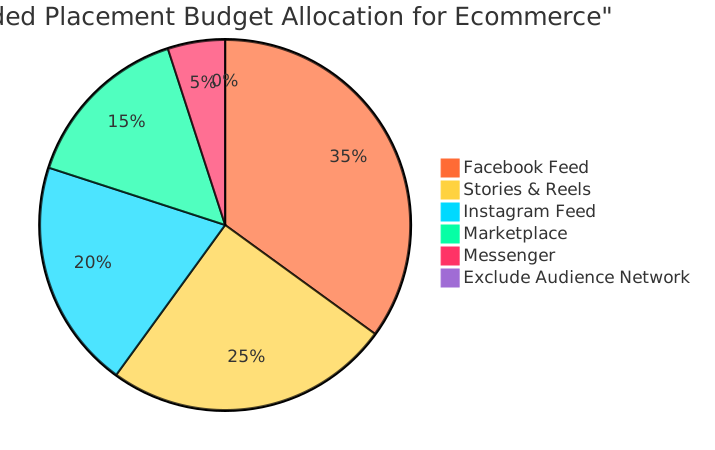
For conversion campaigns, exclude Audience Network entirely.
Let Facebook optimise across the remaining five placements and you’ll see immediate improvement in cost per acquisition.
Ad Format Battle: Carousel Delivers 35% Better ROAS Than Single Images
Format matters more than most advertisers realise.
Carousel ads achieve 4.2X ROAS compared to 3.1X for single images and 2.5X for video according to Lebesgue’s analysis of 1,000+ ecommerce accounts.
That’s a 35% ROAS advantage over single images just by changing format.
Why Carousels Win for Ecommerce
The data reveals three performance drivers…
Multi-product showcase capability. Fashion retailers can show 5-10 different products in one ad. Furniture stores can display living room sets from multiple angles. The user swipes through, finds what they like, clicks to that specific product page.
Sequential storytelling. Rather than cramming everything into one image, carousels let you tell a story across 3-10 cards. Card 1: The problem. Card 2: Your solution. Card 3: Social proof. Card 4: The offer. Card 5: The CTA.
Lower cost per conversion. Carousel ads deliver 20-40% higher conversion rates than single images with 22% lower customer acquisition cost ($35 vs $45 in Lebesgue’s data).
The combination creates compounding advantages.
Video Ads: Length Matters More Than Quality
Video ads generate 35% higher click-through rates than static content when properly optimised.
The catch? Most video ads are poorly optimised.
Here’s what the data shows works…
Videos under 15 seconds achieve highest completion rates. Users will watch the whole thing, absorbing your full message.
15-30 seconds provides optimal CTR performance. Long enough to tell a story, short enough to maintain attention. This is the sweet spot for most direct response campaigns.
Videos exceeding 60 seconds show significant viewership decline with completion rates dropping precipitously. Yet Facebook’s algorithm actually prefers longer engaging content (3-5 minutes) for quality audiences if users genuinely watch.
The recommendation? Start with 15-second videos for cold audiences, test 30-60 seconds for retargeting warm audiences who know your brand.
Lead Generation Ads: The Friction Reducer
Lead generation ad format delivers 7.72% average conversion rate in 2025 with $27.66 average CPL.
That’s substantially better than sending users to landing pages.
Why?
The form appears directly in Facebook without requiring users to leave the platform. Auto-fill populates their name, email, and phone number from their Facebook profile. One tap submits the form.
Compare that to traditional landing pages…
User clicks ad → Page loads (2-3 seconds on mobile) → User sees form → User manually types email address on mobile keyboard (annoying) → User types phone number (more annoying) → User submits → Thank you page loads.
Each step loses 20-30% of users.
Lead gen ads eliminate 4 of those 6 friction points.
The result? 2-3X higher conversion rates versus landing page funnels.
The downside? Lead quality concerns emerged in 2025 with some advertisers reporting 2X worse quality using automated Advantage+ targeting versus manual interest-based targeting, particularly for B2B campaigns.
Best practice: Test both lead gen ads and landing page funnels, tracking not just CPL but also lead-to-customer conversion rate downstream to determine true ROI.

For ecommerce businesses, carousel ads are the default format.
Test others, but expect carousel to win 70% of the time.
User-Generated Content Crushes Professional Creative by 300%
This might be the most important insight in this entire post.
User-generated content drives 6.9X higher engagement than brand-generated content according to Facebook’s official data.
And real-world case studies show even more dramatic results…
Nike’s UGC ads generated 3X as many clicks versus stock photos.
Zara’s UGC ads delivered 2.5X more clicks with lower costs.
When Zara tested UGC on landing pages, it generated 4X more “Buy Now” clicks than pages using stock photography.
The UGC Case Studies That Prove It
Yotpo’s case study demonstrated:
- 4X higher CTR
- 50% drop in CPA
- 50% drop in CPC
- Results sustained over 5 months
Crown Resorts achieved:
- 40% more impressions
- 21% lower CPM
- 25% increase in positive sentiment
A J Hackett Bungy saw:
- 44% CTR increase
- 69% engagement increase
- 13% cost decrease
These aren’t outliers.
85% of users say visual UGC is more influential than brand content.
93% of consumers turn to UGC when making purchasing decisions.
Consumers are 2.4X more likely to view UGC as authentic versus traditional advertising.
Why UGC Works So Well
The performance advantage stems from psychological factors…
Authenticity beats polish. A customer’s shaky iPhone video of your product in their home feels more real than a $5,000 studio production. That authenticity translates to trust.
Social proof at scale. Seeing 10 different customers post about your product signals popularity more effectively than you claiming “thousands of happy customers.”
Algorithm preference. Facebook’s relevance score rewards engagement. A 1% increase in post engagement creates a 5% decrease in cost per engagement—creating a compounding advantage for UGC campaigns that naturally generate more engagement.
How to Actually Get UGC
Most businesses struggle with UGC because they don’t ask for it properly.
Here’s what works in the Australian market…
Run a giveaway. “Post a photo using our product with #YourBrandName for a chance to win $500 gift card.” You’ll get 50-200 submissions depending on your audience size, then have permission to use those images in ads.
Email existing customers. “Would you be willing to share a quick 30-second video about your experience? We’ll send you a $50 voucher as thanks.” Response rate: 5-10%.
Feature customers in your ads (with permission). When someone posts about your product on social media, comment: “Love this! Mind if we share it in our ads?” Most people say yes because it’s flattering.
Hire micro-influencers for UGC creation. Rather than paying for their audience reach, pay them $100-300 to create 3-5 pieces of content you own the rights to. This is dramatically cheaper than hiring production companies.
The content doesn’t need to be perfect.
In fact, imperfect content often outperforms.

If you’re still using only stock photos and professional product shots in your Facebook ads, you’re competing with one hand tied behind your back.
UGC is the creative advantage that actually moves the needle.
Broad Targeting Now Outperforms Lookalikes Post-iOS 14.5
This represents a complete reversal of historical best practices.
Broad targeting delivers 49% higher ROAS (113% vs 76%) with 45% lower CPM than lookalike audiences according to 2024-2025 Lebesgue analysis.
Five years ago, that statement would’ve been laughable.
What Changed? iOS 14.5 Broke Everything
When Apple launched iOS 14.5 on April 26, 2021, less than 25% of Apple users globally opted into tracking (just 10% in the US).
With over 80% of iPhone users worldwide opting out and 46% of Facebook traffic coming from iPhone users, the impact rippled immediately.
Facebook lost the data it needed to build accurate lookalike audiences.
Demographic breakdowns disappeared. Age, gender, and location now show as “null” for opted-out users.
Retargeting audiences shrank significantly. Your website visitor pixel might’ve tracked 10,000 visitors pre-iOS 14.5. Post-iOS 14.5? Maybe 3,000 trackable visitors.
Lookalike audience quality reduced dramatically because the source audiences were 70% smaller and less accurate.
How Facebook’s AI Compensated
Here’s the counterintuitive part…
Facebook’s algorithm actually got better at finding converters by using broader targeting.
How?
Larger data pools. When you target “everyone in Australia aged 25-54,” Facebook’s AI has 10 million people to analyse and learn from. When you target “business owners interested in marketing software,” you’re giving it 50,000 people.
The algorithm needs volume to learn.
Pattern recognition at scale. With broad targeting, Facebook’s AI identifies patterns you’d never notice. “Users who engage with pet content between 8-11 PM convert 40% better.” “People who’ve liked 3+ restaurant pages respond to food imagery.” “Users active on weekends convert at 2X rate.”
These micro-patterns only emerge with massive datasets.
Fewer advertiser restrictions. Detailed targeting constraints force the algorithm to bid on limited inventory. Broad targeting lets it find converters wherever they exist, paying only what’s necessary to win the auction.
The result? Broad targeting now delivers better ROAS at lower cost.
When Lookalikes Still Work
Lookalikes aren’t dead.
But you need to follow specific rules…
Use 1% lookalikes only. AdEspresso’s $1,500 experiment showed $3.75 CPL for 1% versus $4.16 for 5% (+11% higher) and $6.36 for 10% (+70% higher).
Source audiences of 5,000-20,000 users. Under 5,000 lacks statistical significance. Over 50,000 actually reduces performance because the audience becomes too broad to define patterns.
Use purchase events, not traffic. A lookalike based on “people who added to cart” performs worse than “people who purchased $100+.” Quality of source data matters more than quantity.
Test quarterly, not monthly. Lookalikes need time to stabilise. Testing new lookalikes weekly wastes budget on learning phase that never completes.

For most Australian businesses, broad targeting should be your default strategy in 2025.
Test lookalikes, but expect broad to win.
Best Times: 6-9 PM Peak with Q4 Costs Doubling
Timing your Facebook ads properly can improve ROAS by 10-20%.
The data shows clear patterns…
Evening hours from 6-9 PM deliver highest engagement across most industries and demographics. This represents prime time when Australians unwind after work, scroll through Facebook, and actually pay attention to what they see.
The 8-9 PM hour shows peak social media usage as parents complete bedtime routines and professionals finish dinner.
Morning rush (6-9 AM) captures commuters and early risers checking phones first thing.
Lunch breaks (11 AM-1 PM) provide mid-day engagement spikes.
Day-of-Week Performance
Tuesday through Thursday perform best for most campaigns with weekday emphasis for B2B audiences during work hours.
Weekends favour B2C brands and leisure browsing, with Sunday showing increased engagement as users plan their upcoming week.
But here’s the thing…
The recommendation is to run campaigns 24/7 initially to gather performance data before implementing day-parting.
Why?
Facebook’s algorithm needs data from all time periods to understand when your specific audience converts best. Restricting hours too early prevents learning.
Once you have 50+ conversions across all days/times, then implement day-parting based on your actual performance data.
Q4 Holiday Season: The Cost Explosion
Q4 holiday season sees CPM costs double the yearly average according to 2023 data.
25%+ spikes are typical during Black Friday/Cyber Monday week.
The timeline shows…
October 1 through Thanksgiving: Costs manageable, good testing window
Thanksgiving through December 10: Peak pricing, high competition, maximum volume
December 11-23: Costs remain elevated but declining slightly
December 24+: Costs drop precipitously as shipping deadlines pass
January: Cheapest CPMs of the year (30-50% below Q4 peaks)
Despite higher Q4 costs, conversion campaigns showed 20% year-over-year performance increases with 3.3X ROAS using Meta Advantage+—making the season profitable despite premium pricing for brands with strong offers.
Budget Timing Strategy for Australian Businesses
Here’s what works…
Test in January-February when costs are lowest. Validate your audience, creative, and offer at minimum CPMs. Scale what works into March-November.
Maintain consistent spend March-October capturing your market share at normal rates. Don’t go dark for months or you’ll lose algorithmic momentum.
Scale 50-100% in November-December for seasonal businesses. Yes, costs double, but so does consumer intent and purchase behaviour.
Pull back December 24-31 unless you’re restaurants, entertainment, or travel. Most retail shopping is complete by Christmas Eve.
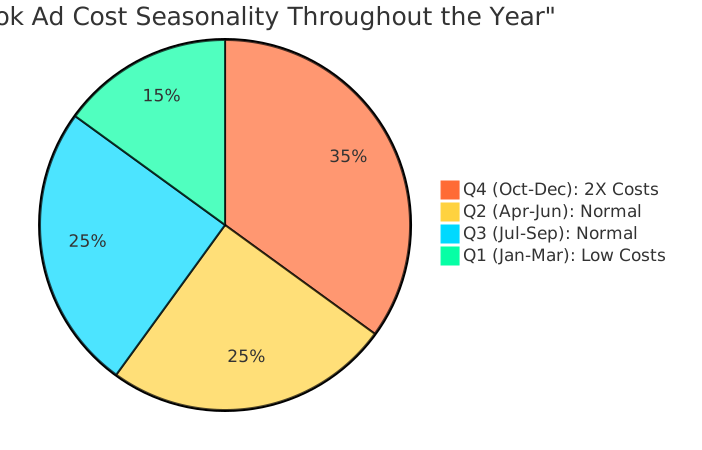
Consumer spending increases beginning and middle of each month (“paycheck effect”), creating intra-month patterns worth testing for B2C businesses.
Day-parting works best for local businesses with specific operating hours, limited budgets, or audiences with consistent daily patterns.
For broad awareness campaigns with diverse audiences, skip day-parting and let Facebook optimise delivery across all hours.
Campaign Budget Optimisation Delivers 17% ROAS Lift
CBO (Campaign Budget Optimisation) provides 17% ROAS lift within 6 weeks when switching from ad set budgets according to Facebook data.
That’s nearly $17,000 additional profit per $100,000 spend.
The reason? Facebook’s AI automatically allocates budget to best-performing ad sets based on real-time performance.
When CBO Outperforms Manual Budgets
CBO works brilliantly for…
Scaling proven winners. Once you’ve validated an audience converts profitably, CBO lets you increase total budget whilst Facebook finds the optimal distribution.
Campaigns with similar audience sizes. If you’re testing 5 lookalike audiences of roughly equal size, CBO will quickly identify the best performer and shift budget accordingly.
Broad targeting where algorithm optimisation outperforms manual control. When targeting “all Australia,” you can’t possibly predict which segments convert best. Let Facebook’s AI figure it out.
Multi-audience campaigns. Running 10 ad sets targeting different interests? CBO identifies which 2-3 actually drive conversions and shifts budget away from the losers.
When Manual Ad Set Budgets Still Win
Ad Set Budgets (ABO) maintain value for…
Testing new audiences. When testing 5 completely different audience types, you want equal budget on each to gather statistically significant data. CBO might allocate 80% budget to one audience before you’ve learned anything about the others.
Niche targeting. Small, specialised audiences (5,000-20,000 people) might get outbid by larger audiences in CBO. Manual budgets ensure your niche gets tested properly.
Different bid strategies per audience. If you’re testing Cost Cap on retargeting whilst using Lowest Cost on cold traffic, you need separate ad sets with independent budgets.
Retargeting specific segments. When you want to spend exactly $500/month retargeting past purchasers, manual budgets provide predictable spending per segment.
The Hybrid Approach That Works
The recommended strategy? Allocate 60-70% budget to CBO for scaling and 30-40% to manual ad sets for testing.
Start campaigns using ABO to validate audiences.
Once an audience shows consistent profitability over 7-14 days, move winners into CBO campaigns to scale.
This gives you the testing control of ABO combined with the scaling efficiency of CBO.

Budget scaling must never increase more than 20% every 3-7 days to avoid resetting learning phase and disrupting performance.
Alternative “horizontal scaling” (duplicating campaigns with higher budgets) enables faster scaling without disrupting existing performers.
For well-performing campaigns, increase budget by 6-10% every 2 days as a more aggressive but sustainable approach.
Meta Advantage+ Slashes Costs 44% (But Quality Concerns Remain)
Advantage+ campaigns deliver 44% lower cost per result versus manual campaigns according to Strike Social’s analysis of 1,000+ ecommerce campaigns.
Meta’s official data claims 32% increase in ROAS for product catalog campaigns, 34% higher conversion volume for lead generation with 15% less spend, and 70% year-over-year growth compared to previous manual campaigns.
Sounds incredible.
And for many businesses, it is.
How Advantage+ Actually Works
Advantage+ represents Facebook’s push towards full automation.
You provide…
- Campaign objective (sales, leads, traffic)
- Creative assets (images, videos, copy variations)
- Budget
- Basic constraints (geography, age range)
Facebook’s AI handles…
- Audience targeting
- Bid strategy
- Budget allocation
- Creative testing and rotation
- Placement optimisation
- Timing and delivery
Creative testing reaches unprecedented scale with Advantage+ testing up to 150 creative combinations simultaneously through automated rotation and optimisation.
The system requires robust conversion data… 50+ conversions per week recommended, ideally 1,000+ conversions in past 30 days for optimal AI learning.
When Advantage+ Crushes Manual Campaigns
The performance data shows clear winners…
Broad market products. Clothing, home goods, consumer electronics—products with mass appeal benefit most from Facebook’s AI finding converters across the entire platform.
Established accounts with pixel data. If you’ve been running Facebook ads for 12+ months with consistent conversion data, the AI has enough history to make intelligent decisions.
Ecommerce with diverse creative assets. Brands that provide 20-50 creative variations (different images, videos, copy combinations) see best results as the AI rapidly tests and optimises.
Scaling existing winners. Once you’ve proven a product converts profitably, Advantage+ excels at finding more customers at similar costs.
The Quality Problem Nobody Talks About
Here’s where Advantage+ gets problematic…
Strike Social found lead quality was 2X worse than interest-based targeting despite lower costs when using Advantage+ for lead generation.
B2B campaigns particularly struggle.
Reports of bot traffic and irrelevant leads plague poorly constrained campaigns. The “black box” nature provides limited visibility into decision-making.
Creative fatigue becomes harder to detect through automatic rotation. You might not realise your best ad burned out because Advantage+ just shifts budget to the next-best performer without alerting you.
Best Practices for Advantage+
If you’re testing Advantage+, follow these rules…
Start with 20% budget allocation on best-performing products. Don’t bet the farm immediately.
Provide 20-50 creative assets for optimal AI learning. More variations = better optimisation.
Set basic demographic controls (age, location) without over-constraining. Give the AI room to work.
Give 7+ days before making changes. The learning phase needs time. Avoid over-optimisation.
Monitor cost per result trends weekly with automated alerts for performance thresholds.
Track lead quality downstream, not just CPL. For B2B especially, a 44% cheaper lead that converts 60% worse is actually more expensive.
Refresh creative every 2-3 weeks to prevent fatigue the algorithm can’t detect.
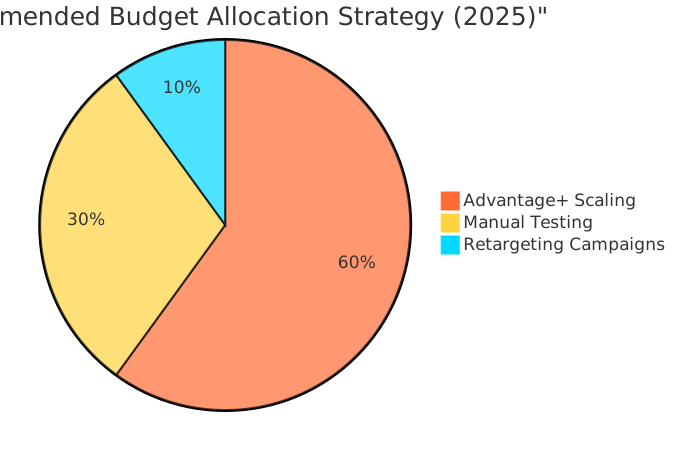
When Advantage+ outperforms: Broad products, established data, diverse creative, scaling phase
When manual campaigns still win: Niche products, new accounts, seasonal timing needs, B2B with quality requirements, complex multi-step funnels (30-40% of budget for testing)
Meta plans complete AI automation by end of 2026 where brands simply input product images and budgets with AI creating entire ads including imagery, video, text, targeting, and budget allocation.
That future is closer than you think.
Facebook Ad Costs Rose 80% Since 2020 (Google Increased 300%)
Let’s talk about the cost trajectory.
Facebook CPM increased from ~$5.31 in 2020 to $8.96-$9.00 in 2024—an 80% increase over five years.
That’s significant.
But before you panic…
Google Ads costs increased 300% in some industries over the same period, making Facebook’s 80% rise look almost reasonable by comparison.
The Year-by-Year Cost Evolution
Here’s how costs evolved…
2020: $5.31 CPM, $0.39 CPC (pre-pandemic baseline)
2021: $6-7 CPM, $0.50 CPC (pandemic surge, iOS 14.5 impact)
2022: $7-8 CPM, $0.55 CPC (post-pandemic normalisation)
2023: $6.06-$8.99 CPM, $0.58 CPC (stabilisation with variance)
2024: $8.96-$9.00 CPM, $0.52-$0.70 CPC (current levels)
2025: $8.96 CPM, $0.70 CPC average (traffic campaigns)
CPC proved more stable than CPM throughout the period, hovering around $0.50-0.70 whilst CPM showed 80% growth.
This relative CPC stability suggests impression supply grew faster than click-through demand—meaning more advertisers joined the platform but users didn’t click proportionally more ads.
Facebook vs Google: The Cost Comparison
Facebook maintains massive cost advantages over Google Ads:
Lead generation: Facebook CPL of $27.66 versus Google’s $70.11 (61% cheaper)
Traffic campaigns: Facebook CPC of $0.70 versus Google’s $4.66 (85% cheaper)
Brand awareness: Facebook CPM of $8.96 versus Google Display’s $12-15 (40% cheaper)
87% of industries saw CPC increases in Google Ads (12.88% average increase) in 2024, making Facebook’s relative stability even more attractive despite its own cost growth.
Google’s 300% cost increases in high-competition industries (legal, insurance, B2B) make Facebook look like a bargain.
Geographic Cost Variations
Geographic CPM variations show dramatic disparities:
| Market | CPM | vs Australia |
|---|---|---|
| United States | $21.00 | +90% |
| Canada | $14.03 | +27% |
| Australia | $11.04 | Baseline |
| Ireland | $11.08 | +0.4% |
| United Kingdom | $10.31 | -7% |
| India | $2.60 | -76% |
An 8X difference between most (US) and least (India) expensive markets.
Australian advertisers occupy a sweet spot… expensive enough to signal quality audiences but cheap enough to remain profitable.
The 2025 Trend: Mixed Signals
2025 benchmarks show contradictory trends:
Good news: Traffic campaign CTR improved to 1.71% (up from 1.57% in 2024) whilst CPC decreased to $0.70 (down 6.7% YoY), indicating improved efficiency.
Bad news: Lead campaigns saw CVR decline to 7.72% (from 8.67%) and CPL surge to $27.66 (up 21% YoY)—a significant cost increase driven by inflation and competition.
The takeaway? Traffic campaigns got more efficient whilst lead generation got more expensive.
Depending on your business model, 2025 could be better or worse than 2024.

Plan for continued 8-12% annual cost increases through 2026 based on historical trends.
Budget accordingly.
Strategic Recommendations for Australian Businesses
Let’s bring this all together with actionable recommendations.
Budget Recommendations
Start with $1,000-3,000 AUD monthly minimum ($20-75/day) for meaningful testing.
Why?
Facebook’s learning phase requires 50+ conversions per week for optimal performance. The formula: average CPA × 50 = minimum weekly budget needed.
If your average CPL is $30, you need $1,500 weekly ($6,000 monthly) to exit learning phase properly.
Going below this threshold keeps you stuck in perpetual learning mode with suboptimal performance.
Allocate 60-70% to CBO for proven products and 30-40% to manual campaigns for testing. This hybrid approach gives you scaling efficiency whilst maintaining testing control.
Plan 20-30% budget increases during Q4 as CPM doubles during holiday season. Either scale to capture seasonal demand or reduce spend if you’re not retail/ecommerce.
Creative Strategy
Prioritise video creative under 15 seconds for optimal completion rates.
Use UGC whenever possible (6.9X higher engagement, 50% lower CPA). Professional creative has its place, but UGC should represent 50-70% of your creative rotation.
Design mobile-first with vertical formats:
- 9:16 for Stories/Reels
- 1:1 for Feed versatility
- 4:5 for maximum feed space
Include captions as 80%+ watch without sound.
Hook viewers in first 3 seconds with bold visuals or text that stops the scroll.
Place CTAs 5-10 seconds into video for maximum engagement (not at beginning or end).
Targeting Strategy
Use broad targeting or Advantage+ rather than detailed targeting post-iOS 14.5.
Broad now delivers 49% higher ROAS with 45% lower CPM than lookalikes in most tests.
When using lookalikes, stick to 1% only with source audiences of 5,000-20,000 users. Avoid 5% and 10% lookalikes that cost 11-70% more.
Allocate 10-20% budget to retargeting (70% more likely to convert) but understand iOS 14.5 limitations shrunk these audiences significantly.
Test Advantage+ with 20-30% budget initially, scaling to 60-70% if quality remains acceptable. Monitor B2B lead quality closely—some see 2X worse quality despite lower costs.
Format and Placement Strategy
Test carousel ads for ecommerce (4.2X ROAS vs 3.1X single image). This should be your default format.
Use lead gen ads for B2B (7.72% CVR average) to reduce friction versus landing page funnels.
Explore underutilised Messenger ($3.64 CPM, 88% open rate, 56% CTR) for direct response campaigns.
Leverage Stories and Reels for 30-40% cost savings versus Feed whilst maintaining engagement. Requires vertical video creative.
Exclude Audience Network from conversion campaigns due to 75% fake click rate. Test only for brand awareness with heavy monitoring.
Frequency and Creative Refresh
Manage frequency caps at 2-4 exposures before ad fatigue sets in.
Set automated rules to pause ads at frequency of 4.
Rotate 5-10 creative variations every 2-3 weeks to maintain freshness.
Monitor relevance scores aiming for 7-10 range, as 1% increase in engagement = 5% decrease in costs through improved algorithmic delivery.
Budget Scaling Rules
Never increase budgets more than 20% every 3-7 days to avoid resetting learning phase.
Use 6-10% increases every 2 days for more aggressive but sustainable scaling.
Alternative: horizontal scaling (duplicating campaigns with higher budgets) enables faster growth without disrupting existing performers.
Bidding Strategy
Use Cost Cap bidding once baseline costs understood (can reduce CPA by 44%).
Start with Lowest Cost automatic bidding for 2-4 weeks to establish benchmarks.
Avoid Bid Cap unless sophisticated with high volume and deep understanding of conversion economics.
Different objectives require different approaches:
- Ecommerce: Cost Cap / Highest Value
- Lead generation: Highest Volume / Cost Cap
- Brand awareness: Lowest Cost without constraints
Technical Implementation
Implement server-side tracking (Conversions API) immediately to compensate for iOS 14.5 limitations.
Build first-party data collection systems (email lists, CRM integration, customer data platforms).
Accept 3-day attribution lag in reporting as the new normal post-iOS 14.5.
Focus on creative quality over hyper-targeting as algorithm optimisation now outperforms manual precision given privacy restrictions.
What This Means for Perth and Western Australian Businesses
If you’re running a business in Perth or regional Western Australia, you’re in a fortunate position.
Perth and regional WA show no CPM premium over Sydney or Melbourne—meaning location doesn’t punish you like it does in the US where New York and San Francisco advertisers pay 30-50% more than midwest markets.
The Australian market’s 46% CPM discount versus the US ($11.04 vs $20.48) applies equally whether you’re in Perth, Fremantle, or Albany.
Local targeting works brilliantly. A 5km radius around your business in Perth captures exactly who can visit whilst eliminating wasted impressions on users too far away to convert.
61% of Australian SMBs using Facebook ads report increased sales according to IAB Australia—proving the platform works for small businesses like yours.
The opportunity is massive.
But only if you understand these benchmarks and optimise accordingly.
The Bottom Line
Facebook advertising in 2025 is dramatically different than 2020.
Costs rose 80%. iOS 14.5 broke targeting. Detailed audiences no longer work. The algorithm demands broad targeting and trusting AI optimisation.
But here’s what hasn’t changed…
Facebook remains the most cost-effective advertising platform for Australian small businesses.
- 61% cheaper lead generation than Google Ads
- 85% cheaper traffic than Google Ads
- 6.9X better engagement with UGC creative
- 49% better ROAS with broad targeting
- 44% cost reduction with Advantage+ automation
The businesses winning in 2025 aren’t the ones with the biggest budgets.
They’re the ones who understand their industry’s specific benchmarks, optimise creative for mobile-first vertical video, embrace algorithmic targeting over manual control, and ruthlessly test everything.
Shopping ads surged 146% in CTR.
Restaurant CPL collapsed 93% to $3.16.
Carousel ads deliver 35% better ROAS than single images.
These aren’t averages. They’re opportunities.
The question is… will you take advantage of them?
Your Next Steps
Ready to apply these benchmarks to your business?
Book a no-obligation consultation with Vikas at RockingWeb. We specialise in rapid prototyping and delivering robust Facebook advertising solutions for Perth and Western Australian businesses.
What you’ll get:
- Free audit of your current Facebook ads (if running)
- Industry-specific benchmarks for your business
- Clear recommendations on budget, creative, and targeting
- No pressure, just honest advice
Or if you’re ready to dive in yourself…
Download our Facebook Ads Benchmarks Spreadsheet with complete data across all 20+ industries, audience targeting templates, and creative brief frameworks.
The data is clear.
The strategy is proven.
Now it’s your turn to execute.
Sources and References
WordStream. (2025). “Facebook Ads Benchmarks 2025: NEW Data, Trends, & Insights for Your Industry.” Analysis of 15,000+ campaigns across 20+ industries. https://www.wordstream.com/blog/facebook-ads-benchmarks-2025{:target=“_blank” rel=“noopener noreferrer”}
IAB Australia. (2024). “Internet Advertising Revenue Report Dec Quarter & CY24.” Market analysis showing $16.4 billion Australian digital advertising spend. https://iabaustralia.com.au/resource/internet-advertising-revenue-report-dec-quarter-cy24/{:target=“_blank” rel=“noopener noreferrer”}
Intensify/Varos. (2024). “Facebook Ads Average ROAS by Industry Benchmarks.” Analysis of 3,000+ accounts across multiple verticals. https://www.intensifynow.com/blog/facebook-ads-roas-by-industry-benchmarks/{:target=“_blank” rel=“noopener noreferrer”}
Triple Whale. (2025). “Facebook Ad Benchmarks by Industry (Updated Data).” Analysis of 11,400 ecommerce accounts. https://www.triplewhale.com/blog/facebook-ads-benchmarks{:target=“_blank” rel=“noopener noreferrer”}
Lebesgue AI CMO. (2025). “Facebook Ads CPM by Country - Data from 2025.” Geographic cost analysis with $3+ billion ad spend data. https://lebesgue.io/facebook-ads/facebook-cpm-by-country{:target=“_blank” rel=“noopener noreferrer”}
Rex Software. (2024). “Facebook Ad Benchmarks: Real Estate ads in Australia.” Analysis of 152 Australian real estate accounts. https://www.rexsoftware.com/articles/facebook-ad-benchmarks-for-real-estate-in-australia{:target=“_blank” rel=“noopener noreferrer”}
Databox. (2024). “Facebook Ads Benchmarks for Your Industry [Original Data].” Survey of 1,294 companies across multiple industries. https://databox.com/fb-ads-benchmarks-by-industry{:target=“_blank” rel=“noopener noreferrer”}
PPC Land. (2024). “Facebook ad costs jump 21% as lead campaigns struggle while traffic ads thrive.” Year-over-year cost analysis. https://ppc.land/facebook-ad-costs-jump-21-as-lead-campaigns-struggle-while-traffic-ads-thrive/{:target=“_blank” rel=“noopener noreferrer”}
Business of Apps. (2024). “Facebook Ads Cost (2025).” Comprehensive cost trends analysis 2020-2025. https://www.businessofapps.com/marketplace/facebook-marketing/research/facebook-ads-cost/{:target=“_blank” rel=“noopener noreferrer”}
Strike Social. (2024). “Complete Guide to Facebook Advertising in 2025.” Advantage+ performance analysis of 1,000+ campaigns. https://strikesocial.com/blog/what-are-facebook-ads-everything-you-need-to-know-to-get-started/{:target=“_blank” rel=“noopener noreferrer”}
Madgicx. (2025). “How to Use Meta Advantage+ to Cut Ad Costs by 44%.” Case studies on AI automation performance. https://madgicx.com/blog/advantage-plus{:target=“_blank” rel=“noopener noreferrer”}
LocaliQ. (2025). “Facebook Advertising Benchmarks for 2025.” Industry-specific CTR, CPC, and conversion data. https://localiq.com/blog/facebook-advertising-benchmarks/{:target=“_blank” rel=“noopener noreferrer”}
Influee. (2024). “Why UGC Performs Better on Facebook Ads.” Case studies showing 4X CTR improvements. https://influee.co/blog/why_ugc_performs_better{:target=“_blank” rel=“noopener noreferrer”}
BMG360. (2024). “Reels vs. Feed Inventory on Facebook and Instagram: A Comparison of Ad Spend.” Placement performance analysis. https://www.bmg360.com/blog/post/reels-vs-feed-inventory-on-facebook-and-instagram-a-comparison-of-ad-spend{:target=“_blank” rel=“noopener noreferrer”}
Social Media Examiner. (2024). “How to Manage Your Facebook Ad Frequency.” Frequency cap best practices. https://www.socialmediaexaminer.com/how-to-manage-your-facebook-ad-frequency/{:target=“_blank” rel=“noopener noreferrer”}
Note: All data represents 2024-2025 benchmarks with Australian-specific insights throughout. Cost figures in AUD unless otherwise specified. Performance varies by industry, campaign objective, creative quality, and targeting strategy. Use these benchmarks as guidelines, not guarantees.
Vikas Thakur
Founder of RockingWeb and experienced SaaS entrepreneur with two decades of expertise in web development, conversion optimisation, and digital marketing. Passionate about helping businesses maximise their online potential through data-driven strategies and cutting-edge technology solutions.
Learn more about Vikas