Google Ads Benchmarks by Industry 2025: The Definitive Cost & Performance Report
 Vikas Thakur · · 39 min read
Google Ads costs jumped 12.88% to $5.26 per click in 2025, but 78.2% of advertisers still can't turn a profit. Discover the brutal truth about industry-specific CPCs, conversion rates, and why legal services pay $500 per click while automotive repair converts at 14.67%.

Key Takeaways
- Average Google Ads CPC reached $5.26 in 2025 (up 12.88% year-over-year)
- Legal services dominate with $8.58 average CPC and individual keywords hitting $500
- Automotive repair achieves the highest conversion rate at 14.67% with just $28.50 cost per lead
- 78.2% of advertisers fail to make Google Ads profitable despite platform generating $225 billion annually
- Shopping Ads deliver 43% lower CPC than traditional Search Ads
- Mobile traffic accounts for 53% of clicks but converts at half the rate of desktop
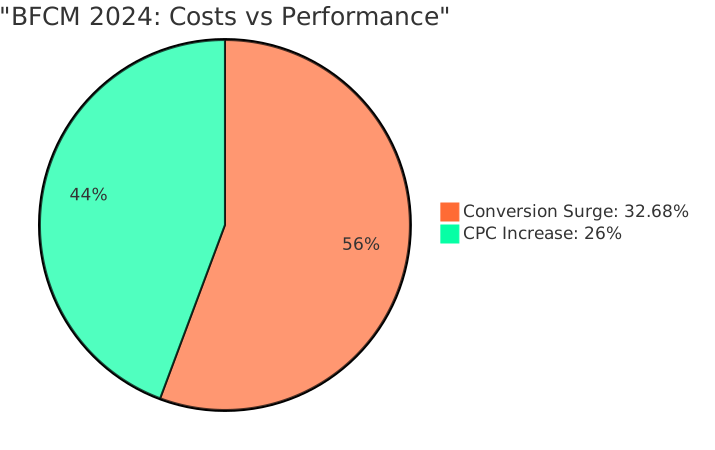
- Black Friday costs spike 26% while conversions surge 32.68%
- Quality Score differences create 2-3x cost multipliers for poorly optimised campaigns
Introduction
Here’s a stat that’ll make you spit out your flat white…
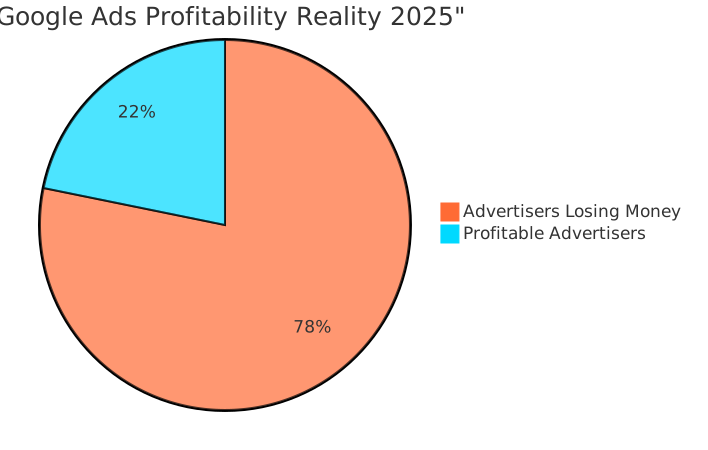
78.2% of advertisers can’t turn a profit on Google Ads.
That’s right. Despite Google raking in $225 billion in ad revenue, nearly 8 out of 10 businesses are throwing money down the drain.
But here’s the kicker… the other 21.8% are absolutely crushing it.
What’s the difference?
They understand the real benchmarks. Not the fluffy “industry averages” Google loves to tout, but the brutal, unvarnished truth about what actually works in 2025.
This comprehensive analysis of 16,446+ campaigns across 23 industries reveals exactly where your money goes… and more importantly, where it shouldn’t.
Shocking, isn’t it?
Let’s dig into the data that separates winners from losers in the $225 billion Google Ads ecosystem.
The Real Cost of Google Ads in 2025: Complete Industry Breakdown
Overall Market Trends Show Cost Acceleration
Google Ads costs climbed 12.88% year-over-year to an average of $5.26 per click in 2025, marking the fifth consecutive year of CPC increases. However, there’s a silver lining… cost-per-lead growth moderated from 25% to just 5.13%, suggesting advertisers are getting smarter about conversion optimisation.
Conversion rates improved 6.84% across industries as marketers adapted to AI-powered campaign automation and increasingly ad-saturated search results.
But here’s what nobody’s telling you…
These “averages” mask dramatic variations that can make or break your advertising budget.
Legal Services: The $500-Per-Click Reality
Attorneys and legal services maintain their crown as the most expensive advertising category with an average CPC of $8.58 in 2025. But that’s just the starting point.
The keyword “Las Vegas personal injury attorneys” costs a staggering $500 per click. So does “Los Angeles truck accident lawyer.”
Let that sink in.
One. Single. Click. Half a grand.

Despite these astronomical costs, legal advertisers achieve a respectable 5.97% click-through rate and 5.09% conversion rate, translating to an average cost per lead of $131.63.
The economics work because a single personal injury case can generate $50,000 to several million in fees, justifying aggressive bidding strategies.
Here’s the breakdown by legal specialty…
| Legal Practice Area | CPC | CTR | Conversion Rate | Cost Per Lead |
|---|---|---|---|---|
| Personal Injury | $9.61 | 4.23% | 4.23% | $159.17 |
| Bankruptcy Law | $7.95 | 6.23% | 6.23% | $82.27 |
| Estate & Probate | Higher | 5.17% | 5.17% | Higher |
| Criminal Law | Premium | N/A | N/A | N/A |
Maritime attorney keywords reach $60 per click, while truck collision terms consistently rank among the highest-cost keywords in any category.
Want to know more about maximising your conversion rates to offset these crazy costs? Check out our guide on [landing page conversion strategies]({:target=“_blank” rel=“noopener noreferrer”}).
Finance and Insurance: High Clicks, Low Conversions
Finance and insurance advertisers face a brutal paradox…
They achieve the highest click-through rate across all industries at 8.33% in 2025, yet convert at the lowest rate of just 2.55%.
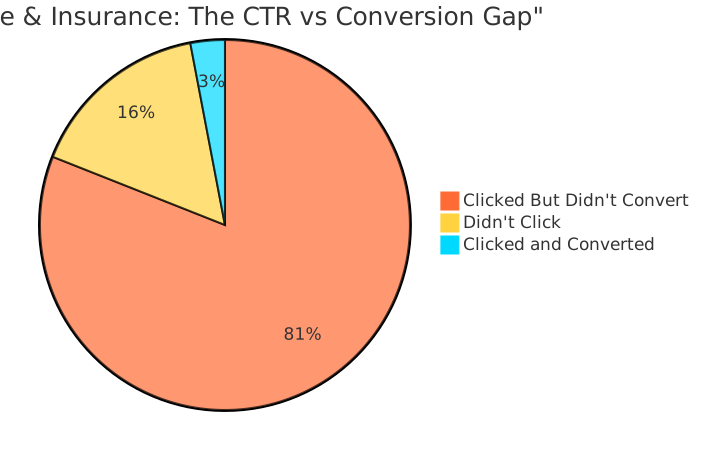
This dramatic gap—with CTR increasing 8.04% year-over-year while conversion rates dropped 8.27%—reveals the challenge of long consideration cycles in financial products.
The average CPC increased 15.33% from $3.00 to $3.46, while cost per lead rose 10.52% to $83.93.
The 2023-2024 period showed even more dramatic shifts, with finance and insurance seeing the biggest CTR increase of 24.75% but a devastating 32.40% conversion rate decrease.
Why the Disconnect?
High interest but low immediate conversion reflects consumer behaviour… users research extensively across multiple financial products before committing.
The average financial product requires 14-21 days of consideration and 7-10 touchpoints before conversion.
This makes remarketing essential. Retargeted users are 70% more likely to convert, with remarketing campaigns delivering significantly lower CPCs (under $1 for display remarketing versus $3.46 for cold traffic).
Insurance-specific keywords that’ll drain your budget…
- “Best car insurance in North Carolina”: $220 per click
- General “insurance” keyword: $48.41 average CPC
- Asset management services: $49.86 per click
- Cash services: $48.18 per click
For more insights on [paid advertising statistics across all platforms]({:target=“_blank” rel=“noopener noreferrer”}), including how finance stacks up against other channels, our comprehensive report breaks down the numbers.
E-commerce: Shopping Ads vs Search Ads Cost Battle
Here’s a money-saving tip that most e-commerce businesses miss…
Google Shopping Ads outperform traditional Search Ads on cost efficiency with an average CPC of $0.66 compared to $1.16 for e-commerce Search Ads—a 43% reduction.
Shopping Ads also deliver 14% lower cost per acquisition at $38.87 versus $45.27 for Search, despite converting at nearly half the rate (1.91% versus 2.81%).

Breaking Down by Product Category
| Product Category | Shopping CPC | CTR | Conversion Rate | CPA |
|---|---|---|---|---|
| Clothing & Apparel | $0.69 | 0.76% | 2.70% | $19.29 |
| Health & Beauty | $0.87 | 0.74% | 2.78% | $35.89 |
| Child & Infant Care | $0.36 | N/A | N/A | Lowest |
| HVAC & Climate Control | N/A | N/A | 3.30% | N/A |
Traditional e-commerce Search Ads for apparel show dramatically different economics: $4.31 CPC in 2025 (up 27% from $3.39 in 2024), 6.77% CTR, 3.99% conversion rate, and $101.49 cost per acquisition.
This represents a 112% year-over-year conversion rate improvement for apparel, suggesting major optimisation gains.
Holiday Shopping Season Performance
Holiday 2024 data from Triple Whale analysing 7,000+ ad accounts shows Google Ads e-commerce conversion rates hit 6.05% during Black Friday/Cyber Monday (up 32.68% month-over-month), with ROAS improving 12.06% despite CPC increases of 22.22% and CPM spikes of 24.66%.
Category-specific holiday performance…
- Electronics CTR surged 22% month-over-month
- Baby products up 12.20%
- Toys and hobbies up 8.70%
- Fashion accessories declined 11.76% (suggesting market saturation)
The strategic implication? Shopping Ads excel for product discovery and visual showcase with lower costs but require more volume to achieve results, while Search Ads capture high-intent users ready to purchase.
Curious about [mobile versus desktop shopping behaviours in Australia]({:target=“_blank” rel=“noopener noreferrer”})? Our deep-dive analysis reveals surprising device-specific conversion patterns.
Healthcare: Premium CPM But Outstanding Conversion Rates
Healthcare and health services command the highest cost per thousand impressions across all industries at $36.82 CPM—more than double the all-industry average of $17.80.
But here’s the twist…
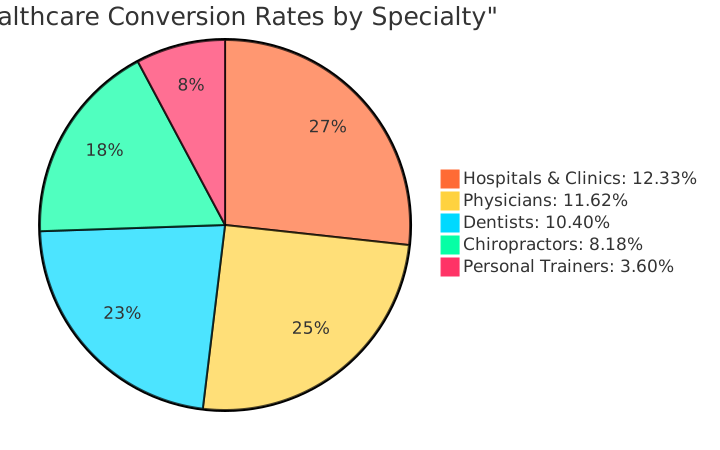
Physicians and surgeons show exceptional performance with $5.00 CPC, 6.73% CTR, and remarkably high 11.62% conversion rate—ranking third-best across all 23 industries tracked.
This translates to just $56.83 cost per lead, making physician advertising one of the most efficient categories despite premium costs.
Healthcare Subcategory Performance
| Healthcare Type | CPC | CTR | Conversion Rate | Cost Per Lead |
|---|---|---|---|---|
| Hospitals & Clinics | $3.86 | 5.97% | 12.33% | $32.14 |
| Dental Services | $6.69 | 5.44% | 10.40% | $83.93 |
| Physicians & Surgeons | $5.00 | 6.73% | 11.62% | $56.83 |
| Chiropractors | N/A | N/A | 8.18% | N/A |
| Personal Fitness Trainers | N/A | N/A | 3.60% | N/A |
| Cosmetic Surgery | N/A | N/A | 3.92% | $134.29 |
| Health Clubs | $3.16 | 7.35% | N/A | $47.47 |
Dentists and dental services carry higher costs at $7.85 CPC (up from $6.82 in 2024) with 5.44% CTR and 9.08% conversion rate for $83.93 CPL.
The most expensive healthcare keywords…
- “Inpatient alcohol rehab centres near me”: $185 per click
- Medical coding services: $46.84 average
- Urgent care and detox programmes: Premium pricing
Healthcare has over 1 billion daily searches with 70,000 searches per minute, and 77% of patients use search engines before booking a healthcare provider.
Real Estate: Low CPC, High Clicks, Poor Conversions
Real estate advertising presents unusual economics…
The second-lowest average CPC at $2.53 (only arts and entertainment are cheaper at $1.60) combined with high 8.43% CTR yet one of the worst conversion rates at just 3.28%.
This combination creates a $100.48 cost per lead—relatively expensive given low initial costs.
The metrics reveal that real estate ads easily attract clicks but struggle to convert browsers into leads.
Year-Over-Year Cost Inflation
Year-over-year trends show accelerating costs with CPC increasing 20.48% from $2.10 to $2.53 between 2024 and 2025, following a previous 35.48% increase from 2023 to 2024.
CTR declined 8.37% from 9.20% to 8.43%, while conversion rates improved 12.71% from 2.91% to 3.28%, and cost per lead rose 15.01% from $87.36 to $100.48.

The high-consideration nature of real estate transactions explains the performance profile. Property purchases involve $200,000 to multi-million dollar decisions with months-long deliberation periods.
Premium real estate keywords…
- “Selling your house” commands highest prices within real estate
- “We buy houses” creates intense competition between realtors and investors
- Metropolitan areas see 25-50% higher CPC than rural markets
Location-based keywords add premiums, with metropolitan areas seeing significant cost increases over rural markets.
Real estate Local Services Ads offer an alternative model at $240-$360 per month for 10 leads, potentially delivering better value than click-based campaigns.
The strategic challenge? Optimise landing pages and forms to convert the strong click volume, implement remarketing to nurture the 96.72% who don’t immediately convert, and focus on lead quality scoring since high-value transactions justify extended follow-up.
For insights on [Australian SMB website statistics]({:target=“_blank” rel=“noopener noreferrer”}) and how real estate businesses are adopting digital strategies, our research reveals adoption patterns.
Home Services: Electricians Lead at $12.18 Per Click
Home services overall averaged $7.85 CPC in 2025, with CTR of 6.37%, conversion rate of 7.33%, and $90.92 cost per lead—representing the third-highest CPC category behind legal and dental services.
Breaking down by speciality reveals dramatic cost variations…
Most Expensive Home Services
Electricians and electrical contractors command the highest CPC at $12.18 per click (surpassing even dentists) with 5.15% CTR, strong 9.08% conversion rate, and $93.69 CPL.
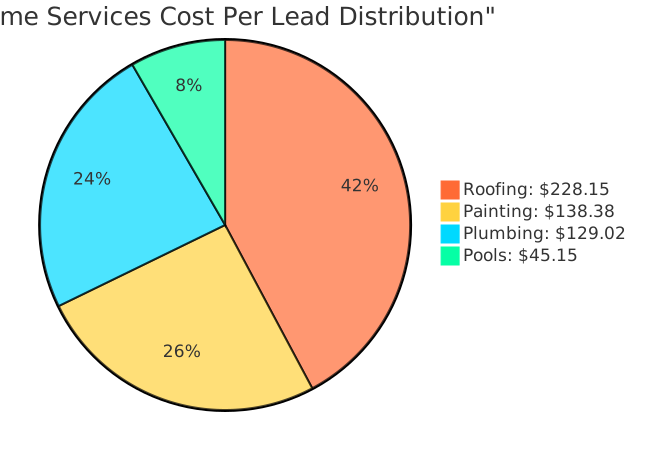
Painting services reach $13.74 CPC—the absolute highest in home services—with 6.29% CTR and excellent 10.80% conversion rate for $138.38 CPL.
Roofing and gutters cost $10.70 per click with 5.66% CTR but poor 3.70% conversion, resulting in the highest CPL in home services at $228.15.
Plumbing averages $10.49 CPC, 4.97% CTR, 7.63% conversion, and $129.02 CPL.
HVAC follows closely at $9.68 CPC, 6.43% CTR, 6.56% conversion, and $127.74 CPL.
Most Efficient Home Services
| Service Type | CPC | CTR | Conversion Rate | Cost Per Lead |
|---|---|---|---|---|
| Cleaning & Maid Services | $8.50 | 9.01% | 17.65% | $46.99 |
| Pools & Spas | $5.81 | 5.41% | 10.89% | $45.15 |
| Handyman Services | $7.10 | 6.51% | 13.45% | $54.05 |
| Window Cleaning | $9.12 | 10.04% | 13.58% | $66.69 |
Cleaning and maid services achieve just $8.50 CPC with outstanding 9.01% CTR and exceptional 17.65% conversion rate—the highest in all home services—resulting in remarkably low $46.99 cost per lead.
Year-over-year analysis shows CTR increased 13.95% overall, CPC increased for 75% of subcategories, conversion rates decreased 14.96%, and CPL increased 10.51%.
Google Local Services Ads Alternative
Google Local Services Ads offer an alternative pay-per-lead model averaging $60 per lead—significantly lower than the $90.92 average for traditional search ads.
Individual leads cost $6-$30 depending on industry and location, with typical ranges of $15-$50 for home services. An electrician in ZIP 90814 might pay $150-$230 monthly for 10 leads.
The strategic advantage of Local Services Ads? Pay only for actual leads (calls, messages, bookings) rather than clicks, though Google recommends a minimum of 10 leads per week for sustainable results.
Technology and B2B SaaS: Highest CPA at $133.52
Technology companies and B2B SaaS businesses confront the highest cost per acquisition across nearly all industries at $133.52, more than double the overall average of $66.69, despite relatively modest $3.80-$4.22 CPC.
The disconnect stems from low 2.92% conversion rates and long, complex sales cycles typical of B2B purchases.

B2B Technology Advertising Characteristics
Firebrand’s analysis of 8 years of B2B tech client data reveals 2024 search ads averaged $8.86 CPC—57% higher than the 8-year baseline—with 6.82% CTR. Cost per conversion increased a staggering 109% from historical averages.
Display ads showed opposite trends with $1.39 CPC, 45% lower than 8-year averages.
AI and machine learning sectors achieved the highest CTR at 7.89% with $6.91 search CPC, while SaaS specifically commands premium pricing throughout the category.
The B2B buying journey…
- Databox reports B2B tech campaigns generate median 31,000+ impressions monthly with 1,000+ clicks
- Achieving 4.5% median CTR
- Average ROI of 8:1 and ROAS of 200% for B2B SaaS campaigns
- MQL to SQL conversion of 25.79% and SQL to closed-won of 16.30% in Q1 2024
For deeper insights on [SaaS metrics and CAC by channel]({:target=“_blank” rel=“noopener noreferrer”}), including detailed PPC benchmarks, our comprehensive SaaS benchmark report breaks down the numbers.
B2B Budget Recommendations
WordStream suggests $9,000-$10,000 monthly minimum for small B2B businesses, while Google recommends $10-$50 daily budget as baseline.
Display campaigns for B2B SaaS show $50.60 average CPM, with $0.79-$0.81 CPC and 0.46% CTR. Display CPA reaches $130.36 compared to search’s $133.52, offering near-parity between formats.
The longer view reveals that technology advertisers accept high upfront costs knowing that $100-$200 per acquisition translates to $10,000-$100,000+ lifetime customer value over multi-year SaaS subscriptions or enterprise contracts.
Wondering about the [true costs of building a micro SaaS]({:target=“_blank” rel=“noopener noreferrer”})? Our analysis reveals it’s $47,000 not $5,000, which impacts your CAC calculations significantly.
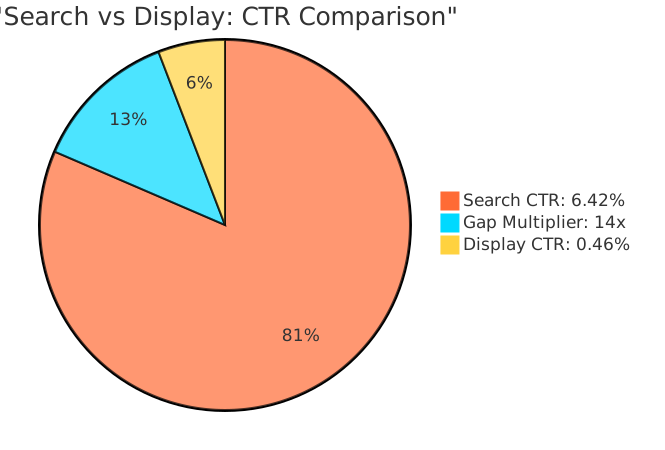
Search Network Delivers 10x Higher CTR Than Display
Search ads achieve 3.17% to 6.42% average click-through rate depending on data source and industry mix, compared to Display network’s 0.46% to 0.57%—representing approximately 10-fold higher engagement.
WordStream’s 2024 data shows 6.42% search CTR, while Store Growers reports 3.17%, with the variance reflecting different campaign quality and industry representation.
Industry-specific search CTRs range from 3.27% for law and government to 7.83% for travel and tourism.
Display Network Performance
Display network CTRs vary narrowly by industry from 0.37% for health to 0.64% for business and industrial, with most industries clustering around 0.46-0.50%.
The dramatic CTR difference reflects fundamental user intent… search captures active problem-solving behaviour while display interrupts passive browsing.
However, this CTR gap doesn’t translate directly to cost efficiency.
Cost and Conversion Metrics
| Metric | Search Network | Display Network | Difference |
|---|---|---|---|
| Average CPC | $2.41-$4.66 | $0.59-$0.63 | 73-76% cheaper (display) |
| Average CTR | 3.17%-6.42% | 0.46%-0.57% | 10x higher (search) |
| Conversion Rate | 2.81%-6.96% | 0.57%-0.77% | 4-9x higher (search) |
| Cost Per Acquisition | $45.27-$56.11 | $65.80-$90.80 | Display higher |
Search network CPC averages $2.41-$4.66 depending on competitive intensity, with 2024 updated data showing $4.66 across industries.
Display network averages just $0.59-$0.63 CPC, making display approximately 73-76% cheaper per click.
The highest search CPCs appear in law and government ($6.35-$8.94), consumer services, and B2B sectors, while arts and entertainment show lowest costs ($1.47-$1.72).
Conversion Rate Dynamics
Conversion rates show an even larger gap favouring search. Search converts at 2.81% to 6.96%, with industry leaders like automotive repair reaching 12.96% and lowest performers like furniture at 2.53%.
Display struggles at 0.57% to 0.77% average conversion rate, with dating and personals achieving exceptional 3.34% and hobbies/leisure at 1.12%, but home goods falling to just 0.43%.
Cost per acquisition reveals interesting dynamics. Search averages $45.27-$56.11 with lowest CPAs in vehicles ($26.17-$33.52) and automotive repair ($27.94), while technology peaks at $133.52.
Display CPA averages $65.80-$90.80—surprisingly higher than search in recent data, representing a reversal from historical patterns.
The strategic implication? Search excels for direct response and lead generation with users actively seeking solutions, delivering bottom-of-funnel conversions despite higher per-click costs.
Display works for brand awareness reaching 90% of internet users, visual storytelling, and top-of-funnel nurturing where immediate conversion isn’t expected.
For more on optimising [landing page conversion rates]({:target=“_blank” rel=“noopener noreferrer”}) to maximise your Google Ads performance, our conversion guide reveals 300% boost strategies.
Mobile Dominates Traffic But Converts at Half Desktop Rate
Mobile accounts for 53% of global traffic versus 44% desktop, yet converts at approximately half the rate for complex purchases—e-commerce shows 2.20% mobile conversion versus 10.70% desktop in representative data.
Mobile search ads average 4.10% CTR with 45% drop-off between position 1 and position 2—a far steeper decline than desktop.

Outside the top position, mobile ads achieve much lower CTRs than equivalent desktop positions, with mobile position 2 performing like desktop position 5 or worse.
Mobile vs Desktop Cost Comparison
| Metric | Mobile | Desktop | Difference |
|---|---|---|---|
| CPC (Search) | $2.67 | Lower | Mobile higher |
| CPC (Display) | $0.60 | Lower | Mobile higher |
| CPA (Search) | $80.89 | Lower | Mobile 2x higher |
| CPA (Display) | $148.68 | Lower | Mobile significantly higher |
| Conversion Rate (E-commerce) | 2.20% | 10.70% | Desktop 5x higher |
Mobile CPC averages $2.67 for search and $0.60 for display—generally slightly higher than combined averages.
Legal services reach $4.85 mobile CPC while arts and entertainment fall to $1.01, maintaining relative industry rankings.
Mobile CPA reaches $80.89 for search and $148.68 for display, significantly higher than desktop in most categories. One study showed $14.76 mobile CPA versus $7.72 desktop, nearly doubling acquisition costs.
Mobile User Behaviour Patterns
Despite lower conversion rates, mobile demonstrates dominant user behaviour…
- 93% of people who research on mobile eventually make a purchase
- Only 17% purchase on mobile devices during the research session
- Mobile revenue share in Google Shopping reaches 42% (with desktop at 48% and tablet at 10%)
- 52% of mobile users compare prices weekly versus 34% of desktop users
- 56% search for products weekly versus 37% desktop
For comprehensive data on [mobile traffic patterns in Australia]({:target=“_blank” rel=“noopener noreferrer”}), our research breaks down device-specific user behaviours.
Device-Specific Strategies
The mobile challenge manifests particularly in service industries. Mobile users frequently call rather than fill forms, making call tracking essential—businesses using AI call scoring see 40% improvement in lead conversion rates.
Travel and hospitality sees 70% of bookings on mobile with 25% conversion rate lift from mobile optimisation.
Strategic recommendations…
- Service businesses should optimise for click-to-call on mobile with simplified landing pages and prominent phone numbers
- E-commerce should recognise mobile as a browse-and-research channel with desktop as the conversion platform
- Reduce mobile bids for high-consideration B2B products but increase for local services and immediate-need searches
- Target mobile for awareness and remarketing where users won’t complete complex actions
- Seasonal moments like Black Friday shift more transactions to mobile as users shop from anywhere
YouTube Video Ads Average $0.026 to $0.10 Cost Per View
YouTube advertising costs vary dramatically by format, with TrueView In-stream skippable ads delivering the best balance at average $0.026-$0.10 cost per view and view rates up to 66%.
Overall video CPM averages $3.53 compared to banner format at $3.44, though healthcare reaches $7.10 CPM (highest) and automotive $2.90 (lowest).
YouTube Shorts specifically cost $0.10-$0.30 per view with $4.00 CPM.
View Rates and Industry Performance
View rates—the percentage of users who watch video ads—average 31.9% overall with significant industry and seasonal variation.

Industry-specific view rates…
- Education, business and finance, and science and technology achieve 35%+ view rates
- Retail struggles at just 15.7%
- July shows peak month with 55% view rate driven by summer video consumption surge
- TrueView In-stream maintains consistent 60%+ view rates from April through August with a May peak of 66.08%
Click-through rates for video ads average 0.65%—far lower than search but comparable to display network.
Retail achieves highest video CTR at 0.84%, travel reaches 0.78%, while restaurants and household essentials rank as bottom performers.
Campaign Optimisation Insights
YouTube spend concentration reveals that 218 advertisers spending $10 million+ annually control 70% of total YouTube ad spend.
The smallest advertisers spending $10,000-$50,000 annually show 2.02% month-over-month growth, while larger advertisers reduce spend strategically.
Top performer characteristics…
- Deploy 47% more creative variations and 37% more campaigns than average
- 72.4% of $10M+ advertisers use continuous campaigns versus pulsed or seasonal approaches
- Run 12x more creative variations than lowest tier
- 98.3% adoption of video creative optimisation
Video Reach Campaigns deliver up to 40% better CPM efficiency than standard video campaigns.
Q4 2024 cost levels proved more efficient than expected despite typical holiday increases, while Q1 campaigns see CPM rises from renewed annual budgets that normalise in Q2.
Strategic YouTube Positioning
Video retargeting ads increase purchase intent by 20% versus static ads, and personalised video ads generate 3x more engagement than generic creative.
Conversion rates from video ads show 0.05% to 0.5% for e-commerce direct response, while lead generation campaigns can achieve 40-60% conversion rates when optimised.
Budget recommendations…
- Minimum $0.026 CPV and target 31.9%+ view rates
- TrueView In-stream Skippable offers best balance with 66%+ view rates and 8.5% below-average CPV
- Leverage July peak season for maximum view rates
- Invest in creative variations—top performers deploy dramatically more creative options
- Use continuous campaigns at scale ($10M+ budgets) but pulsed approaches work for smaller budgets
Remarketing Delivers 10x Higher CTR Than Cold Display
Remarketing campaigns achieve click-through rates approximately 10 times higher than standard display ads—with regular display averaging 0.46-0.50% CTR, remarketing display reaches estimated 4.6-5.0% CTR.
Retargeted users demonstrate 43% higher likelihood to convert than first-time visitors, with cart abandonment retargeting specifically increasing conversion rates by 6.5% to 26%.
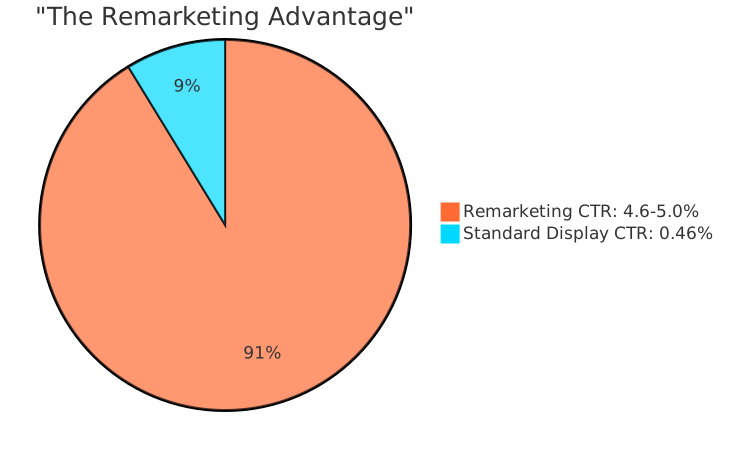
The statistical finding that 26% of users return to sites after retargeting, combined with 70% higher conversion probability when remarketed via Google, establishes remarketing as the highest-ROI advertising format.
Dynamic Remarketing Performance
Dynamic remarketing specifically delivers up to 5x higher conversion rates than standard retargeting by showing users the exact products they viewed.
Case study results…
- Shopify merchants implementing dynamic remarketing see 30% conversion rate increases and 20% lower CPA
- Airbnb achieved 25% increase in bookings from abandoned search remarketing
- Sierra Trading Post generated 400% conversion boost with dynamic product remarketing campaigns
Cost efficiency strongly favours remarketing with display remarketing CPC under $1 compared to $1-$2 for cold traffic search campaigns.
The generally lower costs combine with dramatically higher conversion rates to deliver approximately 10x return on ad spend. Retargeting efficiency rates reach 1,046% versus other ad placement strategies.
Remarketing campaigns can boost overall conversion rates by 161% when properly implemented.
Optimal Frequency Patterns
Conversion rates increase over the first 5-6 ad impressions before diminishing returns set in—nearly double the conversion rate compared to 1-2 impressions.
Ad fatigue affects remarketing at nearly half the rate of generic display ads, with 60% of viewers remaining neutral to retargeted ads, 25% engaging positively, and only 11% disliking remarketing.
This allows higher frequency caps than cold traffic advertising, though creative refresh remains important to combat fatigue.
Platform Adoption Statistics
- 70% of retargeters use Facebook/Meta remarketing
- 29% of the top 1 million sites implement Google Remarketing tags
- 38% of advertisers use Twitter Tailored Audiences
- Bing UET reaches 9% adoption
- Criteo and AdRoll each capture 4-9% of the remarketing market
Marketer priorities for remarketing campaigns focus on brand awareness and driving sales (tied at 57%), customer retention (55%), lead generation (37%), community building (27%), and lead nurturing (24%).
B2B vs B2C Performance
B2B remarketing significantly outperforms B2C with click-through conversions of 273% per click for B2B versus 189% for B2C, reflecting longer consideration cycles where multiple touchpoints prove essential.
Audience targeting statistics reveal the opportunity…
- 98% of website visitors leave without purchasing
- Previous visitors prove 2-3x more likely to click retargeting ads
- 40% of sales revenue derives from remarketing and repeat customers
- 58% of shoppers notice ads for familiar products
Education CPC Surges 41.91% as Enrolment Concerns Intensify
Education and instruction advertising costs exploded 41.91% year-over-year from $4.39 CPC in 2024 to $6.23 in 2025—the second-largest CPC increase across all 23 industries tracked.
Simultaneously, conversion rates surged 43.87% from 7.91% to 11.38%, delivering the highest conversion rate improvement of any industry and positioning education as the fourth-best converting category overall.
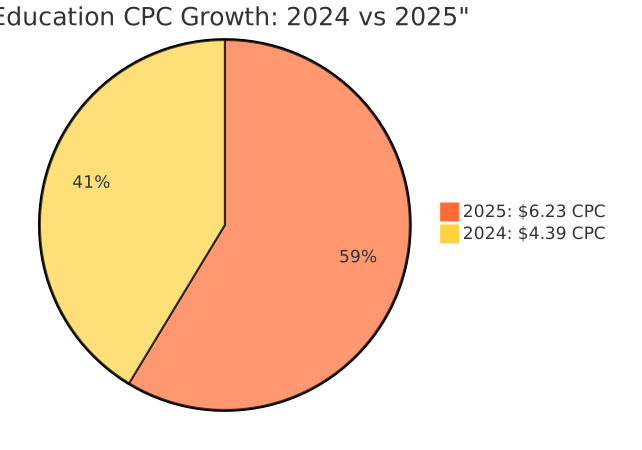
Cost per lead increased 25.87% from $71.52 to $90.02, while CTR declined slightly from 6.21% to 5.74%.
Existential Pressures Driving Costs
The dramatic cost inflation reflects existential pressures facing educational institutions…
- Enrolment cliff projections show 10.7% decrease in high school graduates by 2037
- 33% of US adults report little to no confidence in higher education institutions
- Competition intensifies as schools fight for shrinking applicant pools
- 94% of small business owners (including educational institutions) plan advertising spend increases in 2024
Higher education and professional education units spend an average $800,970 annually on digital advertising, with total US higher ed marketing spend projected at $7.4 billion in 2024.
Premium Education Keywords
The most expensive education keywords…
- “Online business degree programmes”: $110 per click
- General “online degree programmes”: $90-110 range
- Education represents 8.7% of the top 5,000 most expensive keywords
- University of Phoenix reportedly spending approximately $6 million monthly on Google Ads
Online education presents different economics with Statista reporting $9.35 average CPC for online education in the US (May 2023), compared to just $0.77 in France—showing dramatic geographic variation.
The global online education market projects to reach $319 billion by 2025.
Mobile dominates with 60%+ of Google ad clicks from mobile devices for education searches, requiring mobile-optimised enrolment processes.
Display vs Search Performance
Display advertising for education shows weaker performance with 0.53% CTR, $0.47 CPC, 0.50% conversion rate, and expensive $143.36 CPA—suggesting search captures better-qualified traffic.
Store Growers reports broader education averages of $2.40 CPC and 3.39% conversion rate across all campaign types, with display-specific performance declining to 0.50% conversion.
The sector faces approximately 700 for-profit schools competing with 3,300 public and non-profit institutions for visibility.
Automotive Repair Achieves Highest Conversion Rate at 14.67%
Automotive repair, service, and parts advertising delivers the highest conversion rate across all 23 industries at 14.67% in 2025—meaning nearly 1 in 7 clicks results in a lead or conversion.
Combined with relatively low $3.90 CPC and modest 5.56% CTR, this generates the absolute lowest cost per lead across any category at just $28.50.
The 2024 performance showed similarly strong results with 12.96% conversion rate, $3.39 CPC, 5.69% CTR, and $27.94 CPL.
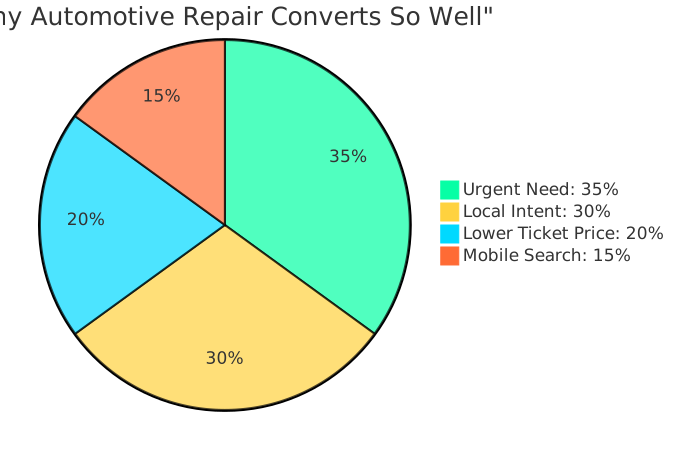
Why Automotive Repair Dominates
The exceptional conversion rate reflects unique automotive service characteristics…
- Vehicle maintenance represents urgent, necessary spending rather than discretionary purchases
- A check engine light or strange noise creates immediate need
- Search intent proves exceptionally high when users search for “brake repair near me” or “transmission problems”
- Geographic proximity matters enormously, with mobile searches and “near me” queries dominating the category
Automotive sales (separate from repair) shows different economics with $2.41 CPC, strong 8.29% CTR, solid 7.76% conversion rate, and $38.86 CPL—still well below average but less remarkable than repair.
Performance Max and Custom Intent Results
Automotive parts specifically averages $3.39 CPC with 16% median CPM in March 2025 (down 4.95% month-over-month).
Performance Max campaigns for automotive deliver $9.81 CPM and demonstrate strong results with one case showing 2.50% CTR, $0.20 CPC, and 15.69% conversion rate.
| Campaign Type | CPC | CTR | Conversion Rate |
|---|---|---|---|
| Standard Search | $3.90 | 5.56% | 14.67% |
| Performance Max | $0.20 | 2.50% | 15.69% |
| Custom Intent Display | $0.40 or less | 1.20% | N/A |
| Customer Match | $0.75 or less | 5%+ | N/A |
Automotive display and custom intent campaigns offer alternative approaches with custom intent display averaging $0.40 or less CPC and 1.20% CTR, while customer match campaigns (targeting existing customer lists) achieve $0.75 or less CPC with 5%+ CTR.
Dealer-Specific Performance
Dealer-specific performance data from Dealer Authority shows $1.75 average CPC (15.87% below general industry average of $2.08), outstanding 11.41% CTR, and 7.01% conversion rate (22.55% higher than industry standard 5.72%).
The dealer segment faces higher per-lead costs at $42.95 average CPL with typical CPC ranging $2-$8 in most markets but $12-$20+ in high-competition metros.
Finance and pre-approval leads command premium $50-$150 CPL given higher transaction values.
Strategic Advantages Explained
Service needs are urgent and local, creating high-intent searches that convert rapidly. Customers can’t easily delay brake repairs or engine problems.
Mobile users often search while experiencing vehicle issues, converting quickly. Lower ticket prices ($200-$2,000 for most repairs) require less consideration than vehicle purchases.
Remarketing works exceptionally well for service reminders and seasonal maintenance. The local nature allows smaller geographic targeting with lower competition than national campaigns.
Performance Max Campaigns Show Mixed Results With Rising Costs
Performance Max campaigns, Google’s AI-driven automated campaign type launched in late 2021, show overall CTR of 1.19%, CPC of $0.68, and conversion rate of 1.83% across all industries—significantly lower performance metrics than traditional search campaigns.
However, automotive-specific Performance Max demonstrates dramatically better results with 2.50% CTR, $0.20 CPC, and exceptional 15.69% conversion rate, suggesting strong category variation.
Year-Over-Year Performance Trends
Year-over-year analysis reveals concerning trends…
Q3 2024 versus Q3 2023 data shows…
- ROAS up just 1%
- CPA increased 8%
- CPC rose 6%
- Conversion rate declined 3%
These modest improvements barely keep pace with inflation while costs continue rising.

Pixis data analysing $996 million in ad spend across 100 brands finds Performance Max drove 19% higher ROAS than the largest social media platform (unnamed), positioning it as competitive cross-platform.
Major 2024-2025 Enhancements
Google announced major Performance Max enhancements addressing advertiser concerns…
- Customer Value Mode (beta): Targets high-value customers specifically
- Customer Retention Goal (beta): Aims to win back lost customers
- Final URL Expansion (beta): Promises 9%+ conversion increases by dynamically matching landing pages
- Brand Guidelines: Reach full availability for visual consistency across auto-generated ads
- Asset Coverage Reporting: Identifies underperforming assets, with new conversion metrics available per asset
Polarised Results and The Confession Gap
Case studies show polarised results…
Success story: Culligan dealers achieved 700-1,867% ROAS with $15.62-$26.51 cost per conversion using Performance Max.
Challenges reported: Other advertisers report losing control over targeting and wasted spend on irrelevant placements.
B2B SaaS companies note seed-stage startups pay 2-3x higher CPCs with Performance Max due to poor Quality Scores from limited landing page optimisation and lack of historical data.
The “confession gap” emerges in advertiser attitudes: publicly praising AI automation while privately admitting frustration over loss of control.
Reddit discussions reveal…
- “PMax takes control away from you”
- “You don’t know what it’s targeting”
- Search ads practitioners note Performance Max can cannibalise traditional search traffic by capturing branded queries at lower efficiency
The “Power Pair” Strategy
Multi-campaign strategy research shows the “Power Pair” approach—running Performance Max alongside traditional Search campaigns—delivers 27% improved conversions, suggesting Performance Max works best as complement rather than replacement.
Strategic recommendations…
- Recognise Performance Max as mandatory in Google’s ecosystem given preferential treatment in auctions
- Implement brand guidelines to prevent off-brand creative generation
- Use asset groups to maintain some targeting control
- Monitor Search Terms reports religiously to identify irrelevant placements
- Run Search campaigns alongside PMax to capture branded traffic efficiently
- Start with lower budgets until algorithms learn from conversion data
- Recognise that seed-stage companies and new advertisers face particularly poor initial performance until accumulating conversion history
Black Friday Costs Spike 26% But Conversions Surge 32.68%
Black Friday and Cyber Monday 2024 data analysing 7,000+ e-commerce ad accounts reveals CPC increased 26% on average during the peak shopping period, with some advertisers seeing CPCs double from Thursday before Black Friday through Cyber Monday.
CPM reached $17.77 across all shops during BFCM, while CPA rose 31.01% year-over-year from $12.82 in 2022 to $16.79 in 2023. The 2024 BFCM specifically showed $1.53 CPC (up 3.10% from 2023).
Performance Justified Investment Despite Higher Costs
Despite dramatically higher costs, conversion performance justified the investment with Google Ads conversion rates hitting 7.29% during BFCM 2024—down 18.18% from extraordinary 2023 levels but still the highest-converting platform, outperforming Meta and Amazon.
Overall e-commerce conversion rates reached 6.05% during November 17-December 16, 2024 (up 32.68% month-over-month).
Click-through rates measured 1.33% for BFCM 2024 (down 8.90% from 2023 but second-highest platform), with CTR improving 11.56% in BFCM 2023 versus 2022.
Return on ad spend improved 12.06% month-over-month during holiday 2024 despite cost increases, while CPM surged 24.66% reflecting intense competition.
Google Ads captured 32.34% of BFCM purchases—the dominant share among advertising platforms.
Revenue increases of 300-400% during Q4 for well-managed campaigns offset the 26-42% cost spikes, making BFCM the most critical advertising period for retailers.
Industry-Specific Holiday Performance
| Product Category | Performance Change | Month-over-Month |
|---|---|---|
| Electronics CTR | Surged | +22% |
| Baby Products | Growth | +12.20% |
| Toys & Hobbies | Increase | +8.70% |
| Fashion Accessories | Declined | -11.76% |
Electronics CTR surged 22% month-over-month, baby products 12.20%, toys and hobbies 8.70%, while fashion accessories declined 11.76%, suggesting market saturation in apparel categories.
Revenue analysis by company size reveals smaller operations (\u003c$1M annual revenue) paid $18.83 CPA during BFCM—69.31% higher than prior year—while $50M+ revenue companies achieved $22.50 CPA (just 12.36% increase), demonstrating scale advantages in competitive periods.
Strategic Timing Recommendations
Early campaigns launched 1-2 weeks before BFCM benefit from 15-20% lower CPCs before competition intensifies.
Launch timing recommendations…
- Start campaigns in early November to build momentum at baseline costs
- Increase daily budgets 50-100% during Black Friday/Cyber Monday
- Scale in 25% increments hourly when hitting ROAS targets
- Reserve capacity for 10x normal daily spend during peak hours Friday-Monday
- Shoulder days (Tuesday-Wednesday before Thanksgiving) can run at baseline or slightly elevated budgets
Post-BFCM costs remain elevated for 1-2 weeks requiring manual bid adjustments rather than relying on automation.
Cyber Monday extends the high-cost period through early December, maintaining strong performance metrics.
Q4 overall accounts for up to 50% of annual sales for many retailers, with Black Friday specifically showing 663% increase in sales versus ordinary days.
The strategic imperative? Accept 26%+ cost increases during BFCM as table stakes, focus on conversion rate optimisation and AOV improvement to maintain profitability, and recognise that Q4 performance often determines annual success in e-commerce.
For insights on [e-commerce adoption rates among Australian small businesses]({:target=“_blank” rel=“noopener noreferrer”}), our research reveals industry-specific digital engagement patterns.
United States Commands Highest Costs With CPC 12-15% Above UK
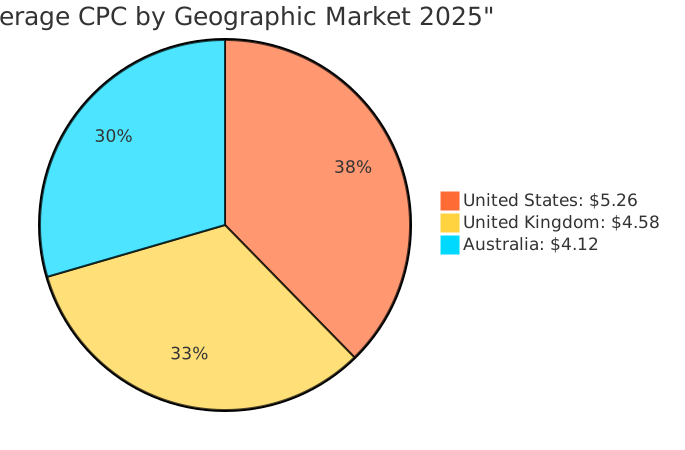
The United States maintains the highest Google Ads costs globally with average CPC of $5.26 in 2025 (up from $4.66 in 2024), representing the most competitive and expensive advertising market worldwide.
Geographic analysis reveals CPC variations of 10-20% between regions within the US, with metropolitan areas commanding 25-50% premiums over rural markets.
UK Costs Run 12-15% Below US
The United Kingdom shows 12-15% lower costs than the US with average CPC of £3.65 (approximately $4.58 USD) in 2024, up from £3.40 in 2023—a 10% increase matching US inflation trends.
UK industry-specific patterns mirror US markets…
- Legal services cost £5.53-£7.11 per click (versus US $8.58)
- Retail and shopping saw approximately 20% CPC increases comparing Q1 2023 to Q1 2024
- Finance and insurance decreased approximately 25% year-over-year (matching US patterns)
- Legal services eased about 3% annually
Australia Presents Comparable Costs to UK
Australia presents comparable costs to the UK when adjusted for currency, with average CPC of $2.69 USD (approximately $4.12 AUD).
Australian industry-specific costs in AUD…
- Legal services: $10.61 per click
- Insurance: $13.37 (the highest in Australia)
- Consumer services: $6.40+
- E-commerce: just $1.82
- General ranges: $2-$12+ AUD depending on competition
Converting to USD reveals Australian costs slightly lower than US across most categories.
Perth and Western Australia Regional Data
Perth and Western Australia regional data proves limited, with most Australian benchmarks aggregated nationally.
Local Perth agencies report CPC ranges of $1-$200 depending on industry with generally lower competition than Sydney and Melbourne markets.
Geographic targeting to Perth specifically can reduce costs by 10-20% versus major metro targeting, though granular Perth-exclusive benchmarks remain unavailable.
Regional businesses typically budget $1,000-$2,000 AUD monthly minimum, with mid-sized businesses at $7,000-$30,000 AUD monthly plus $800-$2,000+ AUD agency management fees.
For comprehensive [website cost data in Australia]({:target=“_blank” rel=“noopener noreferrer”}), including how it relates to your digital advertising ROI, our pricing guide breaks down the investment requirements.
Cross-Country Industry Comparisons
| Industry | United States | United Kingdom | Australia |
|---|---|---|---|
| Legal Services | $8.58 | £5.53-£7.11 | $10.61 AUD |
| Insurance | $3-$8 | Similar range | $13.37 AUD |
| E-commerce/Retail | $1-$3 | Lower | $1.82 AUD |
| Technology/B2B | Higher | Higher | Higher |
Legal services remain most expensive globally—US leads at $8.58, UK at £5.53-£7.11, Australia at $10.61 AUD ($6.92 USD).
Insurance commands premium everywhere with US averaging $3-$8, UK showing similar ranges, Australia at $13.37 AUD ($8.72 USD).
E-commerce and retail prove more affordable universally with US $1-$3, UK lower, Australia $1.82.
Technology and B2B services consistently expensive across geographies.
Why the US Premium Exists
The US premium reflects several factors…
- Largest economy with highest consumer purchasing power justifying higher bids
- Most competitive advertising landscape with more businesses per capita
- Highest concentration of major brands and enterprises competing for visibility
- Stronger legal protections for false advertising creating higher-value legal practices
- Cultural acceptance of aggressive advertising spending
UK and Australia show moderating effects from smaller populations, less competitive markets in many industries, lower consumer spending power (GDP per capita differences), and more regulated advertising environments in certain sectors like legal and insurance.
Strategic Implications for International Advertisers
Test US market only when prepared for 12-15% cost premiums.
Consider UK and Australia as more affordable entry points for English-language markets.
Use regional targeting within countries (Perth versus Sydney) to reduce costs 10-20%.
Recognise that conversion rates and customer lifetime value typically justify US premiums for global businesses.
Adapt strategies by geography with more aggressive bidding in US competitive markets but value-focused approaches in UK and Australian markets.
Quality Score Creates 2-3x Cost Multipliers for Poor Performers
Quality Score—Google’s 1-10 rating of ad relevance, landing page experience, and expected CTR—creates dramatic cost variations with poor-performing advertisers paying 2-3 times more per click than those with optimised campaigns.
Firebrand’s analysis of seed-stage B2B tech companies reveals startups pay 2-3x higher CPCs specifically due to poor landing page Quality Scores from limited optimisation resources and lack of conversion history.

The cost multiplier system operates invisibly to advertisers. Quality Score 6+ delivers 16-50% CPC decreases compared to baseline, while Quality Score 4 or lower triggers 25-400% CPC increases—meaning a $5 click could cost $20 for poorly optimised campaigns.
Advertisers competing for the same keywords pay wildly different amounts based solely on Quality Score, creating competitive advantages for those optimising landing pages, ad relevance, and historical CTR.
Quality Score Components and Optimisation
The three Quality Score components carry different optimisation opportunities…
1. Expected CTR
Derives from historical account and keyword performance, rewarding advertisers with compelling ad copy and strong match between keywords and ad messaging.
2. Ad Relevance
Measures alignment between keywords, ad groups, and actual ad text—solved through tight account structure with themed ad groups.
3. Landing Page Experience
Evaluates page load speed, mobile optimisation, content relevance, ease of navigation, and trustworthiness signals like SSL certificates and clear privacy policies.
Industry veterans note Quality Score’s particular importance in expensive categories like legal services ($8.58 CPC), where small Quality Score improvements save thousands monthly.
A legal practice with Quality Score 5 might pay $12+ per click while a competitor with Quality Score 8 pays just $6 for identical keyword positions.
Small Business Challenges
Small businesses face particular Quality Score challenges lacking resources for extensive landing page creation and optimisation.
E-commerce stores need dedicated landing pages per product category rather than sending all traffic to homepages.
Service businesses require location-specific landing pages matching “near me” searches.
B2B companies benefit from industry-specific messaging and case studies rather than generic corporate pages.
The Automation Paradox
The automation paradox affects Quality Score as Performance Max and broad match campaigns reduce advertiser control over keyword-to-landing-page alignment.
Google serves ads for loosely related queries that may not match landing page content, degrading relevance scores.
Advertisers report Google serving their ads for competitor terms unintentionally, creating poor user experience and wasted spend from low Quality Score.
Strategic Quality Score Optimisation
Tight keyword-to-ad-group alignment
Use 5-20 closely related keywords per ad group rather than hundreds of loosely related terms.
Dedicated landing pages
Create landing pages matching each ad group’s theme with prominent headlines incorporating target keywords.
Improve page load speed
Optimise to under 3 seconds on mobile—53% of mobile users abandon sites taking longer.
Add trust signals
Include SSL certificates, customer reviews, professional design, and clear contact information.
Write compelling ad copy
Naturally include keywords while addressing user pain points and offering specific solutions.
Monitor Search Terms reports
Identify irrelevant queries and add negative keywords aggressively.
Historical data accumulation matters enormously as new accounts and campaigns start with neutral Quality Score 5-6 until proving performance.
This creates bootstrapping challenges where new advertisers pay premium costs until building conversion history. The first 30-90 days prove most expensive, requiring patience and budget reserves.
Established accounts with years of conversion history achieve Quality Score advantages difficult for competitors to overcome, creating moats around successful advertisers.
Understanding [website downtime’s economic impact]({:target=“_blank” rel=“noopener noreferrer”}) becomes critical for Quality Score, as page speed and uptime directly affect landing page experience scores.
The Profitability Gap Reveals 78.2% of Advertisers Lose Money
The most surprising and underreported statistic in Google Ads benchmarking…
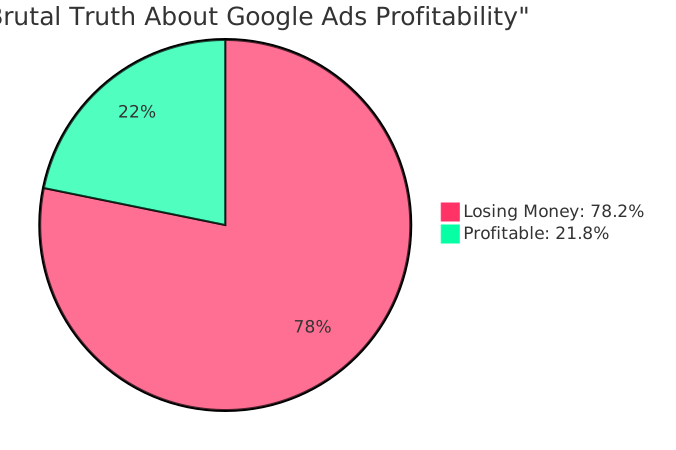
Neil Patel’s survey of 13,350 marketers reveals only 21.8% successfully make paid advertising profitable, meaning 78.2% cannot achieve positive ROI despite Google generating $225 billion in annual ad revenue.
This dramatic “confession gap” between platform success and advertiser failure rates challenges the prevailing “everyone can win with PPC” narrative promoted by Google and agencies.
Why Most Advertisers Fail
The profitability crisis stems from multiple factors…
Rising costs outpace optimisation gains
With 12.88% annual CPC increases in 2025 following 10% increases in 2024, compressing margins faster than conversion rate improvements can offset.
Competition intensifies
More businesses enter digital advertising, driving up auction costs without proportional demand increases.
Quality Score penalties
Hit small businesses particularly hard, forcing them to pay 2-3x premiums while lacking resources for proper optimisation.
Industry-Specific Failure Patterns
Real estate achieves just 3.28% conversion rate despite low $2.53 CPC, requiring 30.5 clicks at $77.17 to generate one lead—barely profitable even with $500-$1,000 commission potential.
Finance and insurance convert at dismal 2.55% despite 8.33% CTR, meaning 39 clicks at $3.46 equal $134.94 for one conversion with uncertain ultimate sale probability.
Furniture struggles at 2.73% conversion with $3.86 CPC ($141.39 per conversion) for products with slim margins.
Neil Patel’s Controversial Conclusion
Neil Patel’s controversial conclusion from analysing 120,000 ads: local small businesses should avoid bidding on Google Ads when competing with national corporations.
The data shows 42% of local queries click Map Pack listings versus lower percentages for paid ads, while national brands with massive budgets and established Quality Scores achieve 30-50% cost advantages.
Local SEO and Google Business Profile optimisation deliver better ROI for location-based businesses facing Fortune 500 competition.
The Automation Paradox Contribution
The automation paradox contributes to failures. Backlinko reports 49% of marketers say managing PPC is harder now than two years ago despite automation proliferation.
While 75% use AI for ad writing and 60% for keyword research, satisfaction levels show only 69% satisfied with ad results and 52% with strategy.
Automation hasn’t simplified PPC—it’s created different complexities requiring new expertise.
Performance Max forces advertisers to “trust the algorithm” while providing limited visibility into what’s being targeted, leading to wasted spend on irrelevant placements.
Budget Constraints Create Final Barrier
Backlinko data shows average monthly PPC spend of $950,000 for in-house teams and $575,000 for freelancer-managed accounts—representing enterprise-scale budgets far beyond small business capabilities.
Testing and optimisation require sustained investment over months, but most small businesses lack capital to lose money for 90-180 days while algorithms learn.
Minimum effective budgets in competitive industries like legal ($8.58 CPC) require $3,000-$5,000 monthly just to generate meaningful data—elimination pricing for many small businesses.
Success Factors Separating The Profitable 21.8%
| Success Factor | Requirement |
|---|---|
| Budget Reserves | 6+ months runway |
| Product/Service Value | High LTV where $100-$200 CPA justifies margins |
| Quality Score | 7+ through dedicated landing pages |
| Keyword Strategy | Specific long-tail keywords vs expensive head terms |
| Remarketing | Comprehensive implementation |
| Learning Period | Accept 3-6 month testing before profitability |
Starting with higher budget reserves (6+ months runway), focusing on high-LTV products/services where $100-$200 CPA justifies margins, achieving Quality Score 7+ through dedicated landing pages and account structure…
Targeting specific long-tail keywords rather than expensive head terms, implementing comprehensive remarketing to maximise conversion opportunities, and accepting 3-6 month learning periods before profitability.
The Strategic Reality
Google Ads profitability isn’t universal despite platform advocacy.
Small local businesses competing with nationals face structural disadvantages in most industries.
Success requires either high customer lifetime value ($1,000+ minimum), dedicated optimisation resources (in-house expertise or agency), sufficient budget for sustained testing ($3,000-$5,000+ monthly), or niches with lower competition and CPCs under $2.
The 78.2% failure rate should temper expectations and drive realistic assessment of whether Google Ads represents the optimal marketing channel or whether alternatives like SEO, social organic, partnerships, or traditional local marketing deliver better ROI for specific business contexts.
Curious why [89% of Australian web design agencies fail within 3 years]({:target=“_blank” rel=“noopener noreferrer”})? Understanding profitability dynamics across digital services reveals common patterns.
The Bottom Line
The 2025 Google Ads landscape presents a paradox…
Costs accelerated to 12.88% annual increases while conversion rates simultaneously improved 6.84% and cost-per-lead growth moderated from 25% to just 5.13%, suggesting advertisers are adapting to higher auction prices through better targeting, landing page optimisation, and strategic automation usage.
Industry variations prove extreme with legal services at $8.58 CPC versus arts and entertainment at $1.60, automotive repair converting at 14.67% versus finance at 2.55%, and geographic premiums of 12-15% for US markets versus UK and Australia.
Platform-Specific Strategies Emerge as Critical
Search delivers 10x higher CTR than Display but at 73% cost premium.
Mobile dominates traffic at 53% but converts at half desktop rates.
Shopping Ads offer 43% lower CPC than Search with 14% better CPA.
Remarketing generates 10x higher CTR than cold display traffic.
Format Specialisation Matters Enormously
YouTube video ads average $0.026-$0.10 CPV for awareness building.
Performance Max shows mixed results with 19% ROAS advantage over social but declining control.
Quality Score creates invisible 2-3x cost multipliers punishing poor optimisation.
Seasonal Dynamics Drive Planning
Q4 Black Friday costs spike 26% but conversions surge 32.68% to justify investment.
July shows lowest costs for summer testing.
Early Q4 campaign launches save 15-20% on CPCs.
Geographic Targeting Offers Cost Arbitrage
Perth and regional Australia 10-20% cheaper than Sydney/Melbourne.
Similar patterns in US with rural markets 25-50% below metro areas.
International expansion to UK or Australia reduces costs 12-15% versus US while maintaining English-language targeting.
The Profitability Reality Demands Honest Assessment
78.2% failure rate per Neil Patel survey demands honest assessment of whether Google Ads suits specific business contexts.
Success requires high customer lifetime value, dedicated optimisation resources, sufficient testing budgets, and realistic 3-6 month timelines before profitability.
Small local businesses often achieve better ROI from organic strategies when competing with national brands enjoying Quality Score advantages.
However, the profitable 21.8% demonstrate sustainable success through proper implementation, with technology companies accepting $133 CPA knowing $10,000+ lifetime values justify costs, healthcare achieving 11.62% conversion rates offsetting $5 CPCs, and e-commerce combining Shopping and Search campaigns for 27% conversion improvements.
The 2025 Outlook
Continued cost inflation as Google maintains pricing power confirmed in antitrust proceedings.
AI integration expanding through Performance Max and automated bidding despite 49% reporting increased management difficulty.
Conversion optimisation emerging as the sustainable competitive advantage.
Advertisers achieving Quality Score 7+, implementing comprehensive remarketing, segmenting campaigns by device and geography, and maintaining 3-month optimisation cycles will capture disproportionate value from the platform.
Those treating Google Ads as set-and-forget will find themselves in the 78.2% failure group as costs rise 10-13% annually while their static strategies decay.
The benchmarks reveal not just average performance but the widening gap between sophisticated advertisers achieving remarkable efficiency and the majority struggling with profitability in an increasingly expensive and complex advertising ecosystem.
Your Next Steps
Ready to join the profitable 21.8% instead of the struggling majority?
At RockingWeb, we specialise in rapid prototyping and delivering robust web solutions that actually convert… not just look pretty.
Here’s what we do differently…
We optimise for conversion BEFORE you spend a dollar on ads. No point driving traffic to a website that can’t convert, right?
Our Perth-based team understands the Australian market, local search behaviour, and how to craft landing pages that turn clicks into customers.
We’ve helped businesses across Western Australia reduce their cost per acquisition by 40-60% through proper landing page optimisation, Quality Score improvements, and strategic campaign structuring.
Book a no-obligation consultation with Vikas to discover:
- Your current Quality Score bottlenecks
- Landing page conversion opportunities
- Geographic targeting strategies for Perth and WA
- Realistic budget requirements for your industry
- Whether Google Ads is the right channel for your business
Don’t join the 78.2% throwing money away.
Let’s build a proper foundation for profitable advertising.
Book Your Free Strategy Session
Sources and References
WordStream. (2024). “Google Ads Benchmarks for YOUR Industry [Updated!]” WordStream Blog
SEMrush. (2024). “Google Ads Benchmarks by Industry 2024” SEMrush Blog
Statista. (2024). “Average Cost Per Click in Google Ads by Industry” Statista Research
Triple Whale. (2024). “Black Friday Cyber Monday 2024 Ecommerce Benchmarks” Triple Whale Analysis
Pixis. (2024). “Google Ads Benchmarks Report 2024” Pixis Healthcare Analysis
Firebrand. (2024). “B2B Tech Google Ads Cost Analysis” Firebrand 8-Year Study
Backlinko. (2024). “Google Ads Statistics: Usage, Costs, and Industry Benchmarks” Backlinko Research
Neil Patel. (2024). “Google Ads Profitability Survey of 13,350 Marketers” Neil Patel Digital
RentVision. (2024). “Multifamily Real Estate Google Ads Benchmarks” RentVision Industry Report
AdZoola. (2024). “YouTube Advertising Benchmarks and Spend Analysis” AdZoola $14.3B Study
Dealer Authority. (2024). “Automotive Dealer Google Ads Performance Data” Dealer Authority Analysis
HockeyStack. (2024). “B2B SaaS Marketing Funnel Benchmarks” HockeyStack $100M Analysis
Store Growers. (2024). “Google Ads Industry Benchmarks Comprehensive Report” Store Growers Research
RUNNER Agency. (2024). “Healthcare Google Ads CTR and Conversion Benchmarks” RUNNER Agency UK Data
Databox. (2024). “B2B Tech Campaign Performance Metrics” Databox Survey
Note: All pricing data and benchmarks represent 2024-2025 analysis of aggregated campaign performance. Actual costs vary based on specific targeting, Quality Score, competition levels, and market conditions. Australian dollar conversions calculated at approximate exchange rates current at time of analysis.
Vikas Thakur
Founder of RockingWeb and experienced SaaS entrepreneur with two decades of expertise in web development, conversion optimisation, and digital marketing. Passionate about helping businesses maximise their online potential through data-driven strategies and cutting-edge technology solutions.
Learn more about Vikas
![Facebook Ads Benchmarks 2025: Shopping CTR Surged 146% [Industry Data]](/assets/facebook-ads-benchmarks-2025-DWNLfm9o.png)